A slice of pizza can be as light as 180 calories or as heavy as 500+ calories. That’s a big gap for one food people often describe with the same simple word: “slice.”
If you’re trying to track your meals, lose weight, or just order smarter, that range can feel annoying. You don’t need a perfect math lesson. You need a clear answer that helps you look at your pizza and make a solid estimate fast.
How many calories in a slice of pizza on average?
The short answer? Most slices of pizza fall between 250 and 350 calories.
That’s the range many people will see for a standard slice of cheese or pepperoni pizza from a restaurant or takeout spot. But “standard” is where things get messy. A small frozen pizza slice and a giant New York-style slice are not playing the same game.
A quick baseline from USDA and chain menus
A good starting point comes from USDA FoodData Central and nutrition menus from big chains like Domino’s, Pizza Hut, Papa Johns, and Little Caesars. Those sources show a similar pattern: plain cheese sits in the mid-200s to low-300s, and heavier toppings push calories higher.
Here’s a simple cheat sheet:
| Pizza type | Typical calories per slice |
|---|---|
| Thin crust cheese | 180–250 |
| Regular crust cheese | 250–320 |
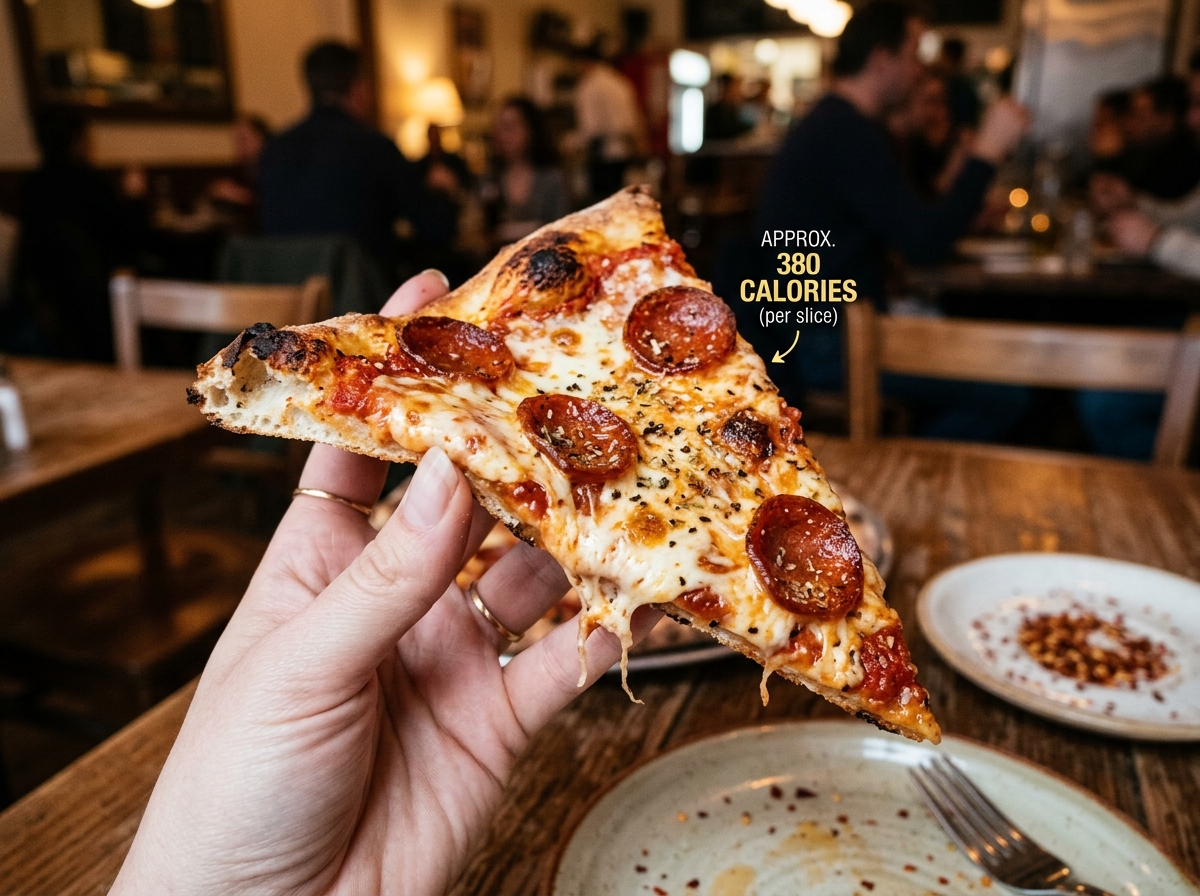
| Pepperoni pizza | 280–380 |
| Veggie pizza | 240–340 |
| Sausage or meat lovers | 320–450 |
| Stuffed crust cheese | 300–420 |
| Deep-dish pizza | 350–500+ |
As a plain reference, the USDA lists a standard cheese pizza slice at about 285 calories and a pepperoni slice at about 313 calories. Real slices can land lower or much higher than that.
What counts as one slice?
This is the part most articles skip, and it matters a lot.
A 14-inch pizza cut into 8 slices gives you a very different slice than an 18-inch New York-style pizza cut into 8 slices. Same number of slices. Bigger pie. Bigger calories.
A frozen pizza can be even more confusing. The box may say 4 servings, but if you cut it into 6 pieces, your “one slice” is not the serving the label uses.
Quick fact: if the pizza is huge, floppy, and wider than your hand, it may be closer to 300 to 450 calories per slice, not 250.
Why pizza calories change so much
If you’ve ever logged pizza in a calorie app and found ten different answers, you’re not imagining things. Pizza calories swing hard because a few details change everything.
Slice size is the biggest factor
Size beats almost everything else.
Think of it like cake. A “slice” can be small and tidy, or it can be the giant piece someone cuts at a birthday party because they love you too much. Pizza works the same way.
A small slice from a medium pizza might land around 200 to 250 calories. A giant food-court slice can cross 600 calories on its own. That’s not because the pizza is magical. It’s because the slice is huge.
Crust, cheese, and toppings add up fast
The crust is the base, and the base matters.
Thin crust often saves calories because it uses less dough. Still, it doesn’t always stay low. If that thin-crust pizza has extra cheese, creamy sauce, and oily toppings, the savings shrink fast.
Cheese is another big calorie driver. A normal amount of mozzarella gives pizza that classic pull and flavor. Add extra cheese, and you add more fat and calories in a hurry.
Toppings can push the number up or down:
- Pepperoni, sausage, bacon, and extra cheese raise calories faster
- Mushrooms, onions, peppers, spinach, and tomatoes usually add less
- Olives and creamy sauces land somewhere in the middle
One topping doesn’t sound like much. But three meat toppings plus stuffed crust? That slice can jump from “normal” to “that was basically a meal.”
Restaurant, frozen, and homemade pizza aren’t the same
A slice from your local pizza shop won’t match a supermarket frozen pizza, and neither will match your homemade pizza.
Restaurant pizza often uses more oil, more cheese, and larger slice sizes. Frozen pizza is easier to track because the nutrition label gives you a clear serving size. Homemade pizza depends on what you used, how much cheese went on top, and how big you cut the pie.
That’s why calorie apps can feel messy. They’re not always wrong. They’re often showing you different kinds of pizza.
Calories by pizza type
Now let’s make this practical. If you’re staring at a menu and want a quick idea of what your slice might cost you, these ranges help.
Cheese pizza
A slice of cheese pizza is the best baseline.
On average, you’re usually looking at 250 to 320 calories for a regular crust slice. A smaller or thinner slice may drop closer to 180 to 250. A very large slice from a big city-style pie may hit 300 to 400 even without meat.
Cheese pizza isn’t automatically “light.” The amount of cheese matters a lot. A cheesy restaurant slice can carry more calories than a simpler pepperoni slice from a smaller pie.
Pepperoni and sausage pizza
Add meat, and the number usually climbs.
A slice of pepperoni pizza often lands around 280 to 380 calories. Sausage can be similar or even higher, depending on how much goes on top. Meat lovers or supreme pizza with several meats often moves into the 350 to 450 calorie range per slice.
Why the jump? Meat toppings bring more fat and often more sodium too. Pepperoni also releases oil as it cooks, which adds flavor but also adds calories.
If your pizza has cups of pepperoni, thick cheese, and a richer crust, you’re not looking at a small upgrade. You’re looking at a real calorie jump.
Veggie pizza
Veggie pizza sounds lighter, and sometimes it is.
A slice of veggie pizza usually falls around 240 to 340 calories. That can be lower than pepperoni, but not always. If the pizza still has a heavy cheese layer, oily crust, or creamy white sauce, the total can stay pretty high.
A veggie pizza with mushrooms, onions, peppers, and spinach on a regular crust can be a smart middle ground. It feels satisfying, but it doesn’t get weighed down by extra meat fat.
Still, don’t let the word “veggie” fool you into thinking every slice is low-calorie. The crust and cheese still do most of the heavy lifting.
Deep-dish, stuffed crust, and meat lovers
This is where pizza calories can get wild.
A slice of deep-dish pizza often sits around 350 to 500 calories, and big slices can go beyond that. Stuffed crust usually adds extra cheese into the edge, so you may see 300 to 420 calories per slice even before toppings stack up.
A thick, cheesy, meat-heavy slice is delicious, but it’s closer to a full meal than a quick snack.
If you’re ordering deep-dish, think in smaller slice numbers. One or two slices can be plenty.
How to estimate the calories in your slice
Let’s say you don’t have a nutrition label. No restaurant menu. No easy tracking entry. You’ve just got a slice in front of you and a guess to make.
Here’s the simplest way to estimate it without overthinking.
- Start with the crust and size.
Thin crust small-to-medium slice: think 180 to 250.
Regular crust standard slice: think 250 to 320.
Large New York-style slice: think 300 to 400+. - Add for meat or extra cheese.
Pepperoni or sausage can add 30 to 100+ calories per slice. Extra cheese can do the same. - Adjust for heavy styles.
Stuffed crust and deep-dish often need a bigger jump than people expect. Add generously, not lightly. - Don’t forget extras.
Dips, garlic butter, ranch, and soda can change the meal more than the pizza itself.
That’s it. You don’t need lab-level accuracy. You need a useful estimate.
A fast restaurant example
Let’s say you grab a large pepperoni slice from a neighborhood pizza shop.
It’s wider than your hand, has a normal crust, and a solid layer of cheese. That’s probably not a 250-calorie slice. A fair estimate would be 320 to 400 calories.
Now picture two of those slices with ranch. Your meal is no longer “just pizza.” It may be closer to 750 to 950 calories, depending on the dip.
A fast frozen pizza example
Frozen pizza is easier because the math is printed for you.
If the box says the whole pizza has 1,120 calories and 4 servings, each serving is 280 calories. If one serving equals a quarter of the pizza, that quarter is the number that matters.
If you slice that same pizza into 8 pieces, each piece is about 140 calories. See the trick? The calories didn’t change. Only the slice size changed.
Pro tip: always read the serving size on the label before logging frozen pizza. A lot of people track the number per serving and forget they ate two servings.
How many calories are in 2 slices or a whole pizza?
This is one of the most common real-life questions, because most people don’t stop at one slice.
Two slices of pizza can mean very different things:
- Two thin crust cheese slices: about 360 to 500 calories
- Two regular cheese slices: about 500 to 640 calories
- Two pepperoni slices: about 560 to 760 calories
- Two deep-dish slices: about 700 to 1,000+ calories
That range explains why pizza can fit nicely into one person’s calorie goal and totally blow past another person’s goal.
Now think about a whole pizza.
A regular 14-inch cheese pizza cut into 8 slices at around 280 calories each gives you roughly 2,240 calories for the whole pie. A meat-heavy or stuffed crust version can push much higher.
That doesn’t mean pizza is “bad.” It just means the total matters. If you’re sharing, great. If you’re eating straight from the box, the calories can sneak up on you fast.
Did you know? A full large pizza can hold close to or more than a full day’s calories for some adults, depending on their age, body size, and activity level.
Can pizza fit into your calorie goal?
Yes, absolutely.
Pizza is one of those foods people love to label as off-limits. That mindset usually makes things worse. You crave it more, then overdo it when you finally eat it.
A better move is to understand the calories, pick your portion, and enjoy it without guesswork.
Smart ways to eat pizza without overdoing it
You don’t need to turn pizza night into a diet lecture. A few simple choices do the job:
- Pick one or two slices on purpose instead of eating straight from the box
- Add a salad or fruit on the side to make the meal feel complete
- Choose thin crust if you want a lighter base
- Skip or limit ranch, garlic butter, and sugary drinks
- Go for veggie toppings more often than extra meat
Those small moves can save a few hundred calories without making the meal feel sad.
A common misconception about “healthy pizza”
A lot of people think thin crust always means low calorie.
Not always.
A thin-crust pizza with double cheese, white sauce, and sausage can still beat a regular crust cheese pizza in calories. The same goes for veggie pizza. If it’s loaded with cheese and oil, it may not be as light as the name suggests.
The smarter question isn’t “Is this pizza healthy?”
It’s “What makes this slice heavier or lighter?”
That question gets you closer to the truth every time.
Warning: sides can change the whole meal
Pizza doesn’t always do the biggest calorie damage. Sometimes the extras do.
A small cup of ranch can add 100 to 150+ calories.
A 20-ounce soda often adds around 230 to 250 calories.
Garlic dip, cheesy bread, and wings can push the meal much higher before you notice.
So if you’re trying to stay within a target, don’t only count the slice. Count what came with it.
If you have a medical reason to watch calories, sodium, carbs, or fat, use the restaurant nutrition page or talk with a registered dietitian. That matters even more if you’re managing diabetes, high blood pressure, or heart disease.
FAQ Section
How many calories are in a slice of cheese pizza?
A slice of cheese pizza usually has 250 to 320 calories. A thinner or smaller slice may be closer to 180 to 250, while a large restaurant slice can reach 300 to 400.
How many calories are in a slice of pepperoni pizza?
A slice of pepperoni pizza often falls between 280 and 380 calories. The exact number depends on the slice size, cheese amount, and crust style.
Is thin crust pizza always lower in calories?
No. Thin crust pizza often starts lower because it uses less dough, but extra cheese, oily toppings, and rich sauces can erase that advantage. Thin crust helps, but it doesn’t guarantee a low-calorie slice.
How can I estimate pizza calories if the restaurant doesn’t list them?
Start with size and crust. A small thin slice is often 180 to 250 calories. A regular crust slice is often 250 to 320. A large New York-style or loaded meat slice may be 300 to 450+. Then add more if you see extra cheese, stuffed crust, or heavy meat toppings.
How many calories are in 2 slices of pizza?
Two slices can range from about 360 calories for smaller thin-crust slices to 1,000 or more for large deep-dish slices. For two average regular slices, 500 to 700 calories is a solid estimate.
Conclusion
Pizza calories aren’t hard once you stop treating every slice like it’s the same size. That one word — slice — hides the real story. Crust, cheese, toppings, and portion size change everything.
If you want the easiest next step, use this rule: count a plain average slice at about 250 to 300 calories, then adjust up for bigger size, meat, extra cheese, stuffed crust, or deep-dish. That simple habit will make your tracking much more accurate.
And yes, you can still enjoy pizza. Just look at the slice in front of you, not the fantasy number you wish it had.