Salsa can turn faster than people think. One day it tastes bright and fresh, and a few days later it smells sour and looks a little suspicious. If you’ve got an open jar in the fridge
Here’s the quick answer most people are looking for.
| Type of salsa | How long it usually lasts in the fridge |
|---|---|
| Homemade salsa | 4 to 7 days |
| Opened jarred salsa | About 1 month |
| Fresh store-bought refrigerated salsa | About 5 to 7 days after opening |
| Restaurant or deli salsa | About 3 to 5 days |
| Salsa with avocado or dairy | About 1 to 3 days |
Those timeframes assume your fridge stays at 40°F (4°C) or below. That’s the food safety standard used by the USDA and FDA for chilled foods.
A lot of confusion happens because “salsa” can mean very different things. A shelf-stable jar you buy from a grocery aisle is not the same as fresh pico-style salsa from a deli case. One is processed and sealed for a longer shelf life. The other is more like a fresh salad in sauce form.
Homemade salsa
Homemade salsa usually stays good for 4 to 7 days in the fridge.
That range works for classic tomato salsa made with ingredients like tomatoes, onions, jalapeños, cilantro, garlic, lime juice, and salt. If you made it fresh at home, count the storage time from the day you prepared it, not the day you remembered to label it.
Fresh salsa doesn’t have the same protection as a commercial jarred product. It may have acid from lime juice or vinegar, but it still contains a lot of moisture and raw produce. That mix spoils faster than many people expect.
If your homemade salsa includes avocado, mango, pineapple, corn, or dairy, cut that time down. Those versions often lose quality faster and can spoil sooner.
Store-bought jarred salsa
An opened jarred salsa usually lasts about 1 month in the fridge.
That applies to the kind sold unrefrigerated on a store shelf. Once you open it, air, moisture, and bacteria from spoons start changing the clock. Even though the jar lasted months unopened in your pantry, it won’t stay that way after opening.
Still, the label matters. If the brand says “use within 2 weeks after opening,” follow that. The maker knows the recipe, the acidity level, and the preservatives used.
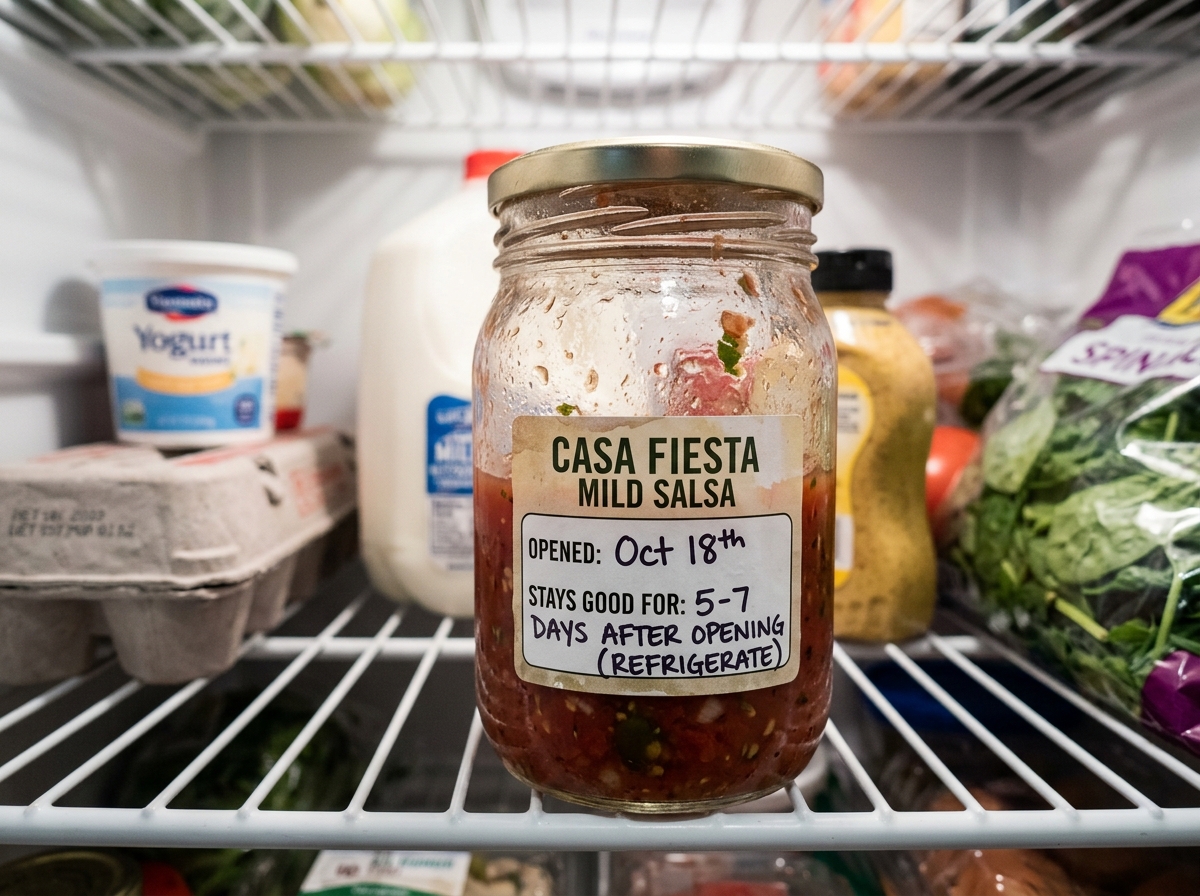
Pro tip: Write the opening date on the lid with a marker. It saves you from the classic “I think I opened this last week… or maybe last month?” problem.
Fresh store-bought refrigerated salsa and restaurant salsa
Fresh salsa from the deli case, refrigerated section, or a restaurant is the shortest-lived kind.
After opening, it’s usually best within 5 to 7 days, and restaurant-style salsa is often safer to use within 3 to 5 days. Why shorter? It’s usually less processed, less acidic, and more exposed to air and handling.
If you brought home salsa from a taco spot and it came in a small plastic tub, don’t expect jar-level shelf life. Treat it like a leftover side dish, not like a pantry condiment.
Quick fact: If the salsa was sold refrigerated, that’s a clue it’s more perishable.
What makes one salsa last longer than another?
Two jars of salsa can look almost the same and still spoil at very different speeds. A few things decide how long yours will stay good.
Acid helps, but it doesn’t stop spoilage
Tomatoes are acidic. Lime juice and vinegar add more acid. That’s one reason salsa lasts longer than, say, a chopped cucumber salad.
But acid isn’t magic.
A bright, tangy salsa may still grow yeast, mold, or bacteria if it sits too long or gets contaminated. Think of acid as a speed bump, not a brick wall.
Jarred salsa usually lasts longer because manufacturers control the pH, use heat processing, and seal the product. Fresh homemade salsa doesn’t get that same treatment.
Fresh add-ins change the clock
A plain tomato salsa can hang on longer than one packed with delicate extras.
A few examples:
- Avocado salsa browns and breaks down fast.
- Fruit salsa with mango or pineapple can get watery and ferment sooner.
- Corn and bean salsa may hold texture well, but the mix still counts as a moist leftover.
- Salsa with sour cream or cheese should be eaten much sooner.
So if you made a chunky salsa for a barbecue and tossed in corn, black beans, and avocado, don’t use the same timeline you’d use for a simple jarred red salsa.
The spoon you use matters
This sounds small, but it changes a lot.
Every time you dip a used spoon, a chip, or your finger into salsa, you bring in new bacteria. That makes spoilage happen faster. Double-dipping isn’t just a party problem. It shortens fridge life too.
Using a clean spoon every time gives your salsa a better shot at lasting as long as it should.
Your fridge may be warmer than you think
Many home fridges run a little warm, especially if they’re packed full or the door gets opened all day.
The safe target is 40°F (4°C) or below. If your fridge sits closer to 45°F, salsa can spoil sooner, even if the date seems fine.
Did you know? The fridge door is the warmest spot in most refrigerators. If you want salsa to last longer, keep it on an inside shelf, not in the door.
How to tell if salsa has gone bad
Dates help, but your senses matter too. Salsa usually gives warning signs before it goes fully bad.
Red flags you can see and smell
Throw salsa out if you notice any of these:
- Mold on the surface or around the lid
- A sour, fermented, or yeasty smell
- Bubbles or fizzing that weren’t there before
- A bulging lid on a container
- Slimy texture
- Major color change with an off smell to match
That fizzy smell can catch people off guard. Salsa isn’t supposed to smell like it’s turning into a science project. If it smells boozy, sharp, or oddly fermented, toss it.
Warning: If you see mold, don’t scoop it off and keep the rest. Salsa is a soft, wet food. Mold can spread below the surface, even if you can’t see all of it.
What doesn’t always mean it’s bad
Not every change means danger.
A little watery separation on top is normal, especially in fresh salsa. Tomatoes release liquid over time. If the salsa still smells fresh and looks normal, you can usually stir it and use it.
You may also notice the color gets a little duller after a few days. That alone doesn’t mean it’s spoiled. Fresh ingredients naturally lose some brightness in the fridge.
The trick is to look at the whole picture: smell, texture, date, storage, and appearance together.
Should you taste it to check?
If you already think it might be bad, don’t use a taste test as your main decision tool.
One tiny bite may not seem like a big deal, but foodborne bacteria don’t send a warning text first. If salsa smells wrong, looks sketchy, or has been sitting too long, throw it out.
A jar of salsa costs less than a miserable night with stomach cramps.
Can bad salsa make you sick?
Yes, it can.
Salsa contains chopped produce, moisture, and often raw ingredients. That makes it a decent place for microbes to grow if it’s stored poorly or kept too long. The risk is higher with homemade salsa, restaurant salsa, and any batch left out too long at room temperature.
If you’re serving kids, older adults, pregnant people, or anyone with a weaker immune system, play it extra safe.
Best way to store salsa in the fridge
If you want salsa to stay fresh as long as possible, storage matters almost as much as the recipe.
The safest storage routine
You don’t need a complicated system. Just do these four things:
- Refrigerate salsa quickly. Put it away within 2 hours. If the room is above 90°F (32°C), the limit drops to 1 hour.
- Use a clean, airtight container. Keep the original jar if it seals well, or move homemade salsa to a clean container with a tight lid.
- Store it on an inside shelf. The back of the fridge stays colder than the door.
- Use a clean spoon every time. No chip dipping into the storage jar.
That’s it. Simple habits make a real difference.
Pro tip: Split a big batch into two containers. Keep one for daily use and one sealed until later. That way you’re not exposing the whole batch every time you snack.
What if salsa sat out on the counter?
This is a big one.
If salsa sat out for more than 2 hours, toss it. If it sat out in hot weather or at an outdoor party for more than 1 hour, toss it sooner.
People often think, “It still smells fine, so it must be okay.” Sadly, harmful bacteria don’t always change the smell or look right away.
That bowl of salsa from movie night or game day can cross into unsafe territory fast, especially if people dipped chips straight into it for hours.
Should you keep salsa in the original jar?
For store-bought salsa, yes, that’s usually fine as long as the jar is clean and the lid closes tightly.
For homemade salsa, a glass or BPA-free airtight container works best. Leave a little space at the top so liquid can settle without leaking.
If you made a huge batch, don’t store it in a shallow bowl covered with foil and hope for the best. A proper sealed container keeps air out and helps the temperature stay steady.
Can you freeze salsa?
Yes, you can freeze salsa, and it’s a smart move if you know you won’t finish it in time.
What to expect after thawing
Frozen salsa stays safest for much longer, but the texture changes.
Tomatoes and onions hold a lot of water. Once frozen and thawed, they soften and release more liquid. That means thawed salsa can taste fine but feel looser and less crisp.
For best quality, use frozen salsa within 1 to 2 months.
Homemade salsa freezes better than many people expect, especially if you plan to cook with it later. Chunky fresh salsa for chips? Not always ideal after thawing. Salsa for eggs, soups, tacos, or a simmer sauce? Perfectly useful.
Best uses for frozen salsa
After thawing, salsa works well in:
- scrambled eggs
- taco meat
- chili
- soup
- enchilada filling
- rice bowls
Thaw it in the fridge, not on the counter.
If the salsa looks watery after thawing, stir it well or drain off a little liquid. That’s normal.
Real-life salsa calls: keep it or toss it?
This is the part most articles skip. Real kitchens are messy. Labels get ignored. Dates blur together. So let’s make a few common calls.
“I opened this jar two weeks ago”
If it’s a commercial jarred salsa from the pantry aisle, two weeks in the fridge is usually still within the safe window, as long as:
- it smells normal
- there’s no mold
- the jar stayed cold
- you used clean utensils
If it’s fresh refrigerated salsa, two weeks is pushing it too far for most brands. Toss it unless the label clearly says otherwise and it still looks and smells fresh.
“My homemade salsa is six days old”
This is the classic gray area.
If you made it six days ago, kept it cold, and it still smells fresh, you should either eat it today or toss it soon. I wouldn’t let it drift into the second week and hope for the best.
Homemade salsa doesn’t age like a fine wine. It ages more like chopped salad with attitude.
“The top looks watery”
Watery salsa isn’t always bad.
Fresh tomatoes naturally release liquid. Give it a stir and check the smell. If it smells clean and fresh, you’re probably fine. If it’s watery and sour, fizzy, or slimy, that’s a different story.
“It tastes okay, but the lid made a weird pop”
A small vacuum pop from a chilled jar can be normal. A bulging lid, leaking container, or pressure buildup with odd smell is not normal.
If the jar hisses, spurts, or smells fermented, skip it.
“It’s salsa verde. Does that last longer?”
Not by much.
Salsa verde may be made with tomatillos instead of tomatoes, but the same basic rules still apply. Homemade or fresh salsa verde usually lasts about 4 to 7 days in the fridge. Opened jarred salsa verde often lasts about 1 month, unless the label says less.
4. FAQ Section
FAQ
How long does homemade salsa stay good in the fridge?
Homemade salsa usually stays good for 4 to 7 days in the fridge if you store it in an airtight container at 40°F (4°C) or below. If it contains avocado, fruit, or dairy, use it faster.
Can I eat salsa that has been in the fridge for 2 weeks?
It depends on the type. Jarred commercial salsa may still be okay at 2 weeks after opening if it was stored well and shows no spoilage signs. Homemade, deli, or restaurant salsa is usually too old at that point and should be tossed.
Can bad salsa make you sick?
Yes. Spoiled salsa can grow bacteria, yeast, or mold. That can lead to stomach upset or foodborne illness. If the salsa smells sour, looks moldy, feels slimy, or has been stored too long, don’t eat it.
Does lime juice or vinegar make salsa last longer?
Yes, a bit. Lime juice and vinegar add acid, which can slow spoilage. Still, they don’t make fresh salsa safe for weeks. You still need to refrigerate it properly and use it within the normal time window.
Is watery salsa spoiled?
Not always. Fresh salsa often separates because tomatoes release juice. Stir it and check the smell, texture, and date. If it smells fresh and looks normal, it may still be fine.
Do I need to refrigerate unopened salsa?
If it’s a shelf-stable jarred salsa from the pantry aisle, you usually don’t need to refrigerate it until after opening. If it was sold in the refrigerated section, keep it refrigerated even before opening.
5. Conclusion
If you want the short version, here it is: homemade salsa usually lasts 4 to 7 days, fresh refrigerated salsa about 5 to 7 days, and opened jarred salsa about 1 month. The safest move is to check the type, look at the date, smell it, and trust the warning signs.
If your salsa is right on the edge and you’re not sure, don’t stretch it. Grab a clean spoon, check it once, and if anything seems off, toss it and move on. Your next batch of salsa will taste a lot better than taking a risk with an old one.