A burrito can go bad in two minutes flat. The tortilla gets rubbery, the filling stays cold in the middle, and the bottom turns soggy enough to ruin lunch. If you want to know how to reheat a burrito so it tastes close to fresh, the trick isn’t just more heat. It’s using the right method for the burrito you have.
Why burritos reheat so badly
A burrito is one of those foods that seems simple, but it reheats like a puzzle.
You’ve got a tortilla on the outside that dries out fast. Inside, there might be rice, beans, chicken, steak, cheese, salsa, and maybe even sour cream or lettuce. Those ingredients all heat at different speeds. So the outside gets hot long before the center catches up.
Quick fact: Dense fillings like rice, beans, and meat hold cold longer than cheese or tortillas. That’s why a burrito can feel scorching on the edges and still be fridge-cold in the middle.
Size matters too. A small bean and cheese burrito is easy. A giant restaurant burrito from Chipotle, Qdoba, a local taqueria, or your own kitchen takes more care. The thicker the burrito, the more likely you are to get uneven heat.
The goal is simple: warm the center without wrecking the tortilla.
That usually means one of three things:
- lower heat
- a little more time
- a method that heats evenly, not just quickly
If you’ve been blasting your burrito on full microwave power and hoping for the best, that’s probably where things went wrong.
What’s the best way to reheat a burrito?
The best method depends on what kind of burrito you’re holding.
If you’re in a rush, the microwave is the fastest option. If you care most about texture, the oven, air fryer, or skillet will do a better job. If the burrito is frozen, you’ll usually get better results if you thaw it a bit before trying to crisp it.
Best short answer:
For a refrigerated burrito, the oven at 350°F gives the most even reheat.
For a crispy tortilla, use an air fryer or skillet.
For pure speed, use the microwave.
For a frozen burrito, thaw it a little first, then finish with dry heat.
Refrigerated leftover burritos
A leftover burrito from last night is the easiest to save.
If it’s wrapped in foil from a restaurant, take a second to open it and check what’s inside. If you see lettuce, sour cream, or guacamole, remove them if you can. Those toppings don’t reheat well. They turn watery, wilted, or oily.
A burrito with just rice, beans, cheese, and meat is much more forgiving. You can reheat it with any method.
Frozen burritos
Frozen burritos are trickier because the center is rock hard while the outside wants to dry out.
You can still heat them straight from frozen, but a two-step approach works better. Warm the inside first, then crisp the outside. That’s why people often microwave first and finish in the oven, air fryer, or skillet.
A grocery store frozen burrito and a homemade frozen burrito don’t always behave the same way. Store-bought ones are usually smaller and more uniform. Homemade burritos are often thicker and packed tighter, so they need more time.
Burritos with cold toppings inside
This is where people get annoyed, and honestly, for good reason.
Lettuce goes limp. Sour cream splits. Pico de gallo releases water. Guacamole turns messy. If your burrito already has those mixed in, use gentler heat and keep your expectations realistic. It’ll still be edible, but it won’t taste exactly like it did fresh.
Pro tip: If you make burritos at home, keep hot fillings and cold toppings separate. Reheating gets much easier later.
How to reheat a burrito in the microwave
The microwave is the fastest answer to how to reheat a burrito, and for a lot of people, that’s enough. You’re hungry now, not in 25 minutes.
Still, speed comes with trade-offs. The tortilla can turn chewy, and the filling can heat unevenly if you go too hard.
Best microwave method for a refrigerated burrito
Here’s the method that gives the best balance of speed and texture:
- Remove any foil or paper wrapper.
- Put the burrito on a microwave-safe plate.
- Wrap it loosely in a slightly damp paper towel.
- Heat on 50% power for 1 minute.
- Turn it over, then heat in 30-second bursts until hot.
- Let it rest for 1 minute before eating.
That lower power matters. Full power tends to overcook the tortilla before the center warms up.
Did you know? Resting time helps more than most people think. Heat keeps moving inward after the microwave stops, so that one quiet minute can fix a cool center.
For a medium-size burrito, total microwave time is often around 1½ to 2½ minutes. A very large burrito may need more.
If the middle stays cold
This is the most common complaint.
If your burrito feels hot outside but cold in the center, don’t keep nuking it on full power. Try one of these fixes instead:
- Cut it in half before reheating
- Lower the power setting
- Turn it halfway through
- Let it rest before checking again
A thick steak burrito with rice and black beans needs a different approach than a slim bean burrito.
If the tortilla gets soggy
A damp paper towel helps keep the tortilla soft, but too much moisture can make it limp.
If you hate soggy tortillas, do this: microwave just long enough to heat the inside, then move the burrito to a dry skillet for a minute or two. You’ll get the speed of the microwave and the better texture of stovetop heat.
That combo works especially well for breakfast burritos with egg, potato, cheese, and sausage.
Can you microwave a frozen burrito?
Yes, but don’t expect a crisp outside from the microwave alone.
For a frozen burrito:
- Remove packaging and foil.
- Microwave on 50% power for 2 minutes.
- Flip it over.
- Heat in 1-minute bursts until the center is hot.
- If you want better texture, finish in a skillet, oven, or air fryer.
If the label on a store-bought frozen burrito gives specific instructions, use those as your starting point. Brands test their own products, and sizes vary.
Warning: Never put foil in the microwave. That includes foil from takeout burritos.
How to reheat a burrito in the oven
If you want the most even reheat, the oven is your best friend.
It takes longer than the microwave, sure. But it warms the burrito from the outside in without shocking the tortilla. That means less rubberiness, less sogginess, and a better shot at a hot center.
Oven method for a refrigerated burrito
Use this if you’ve got a leftover burrito from a restaurant or a homemade one from the fridge.
- Preheat your oven to 350°F.
- Wrap the burrito in foil if you want a soft tortilla.
- Put it on a baking sheet or directly on the oven rack.
- Heat for 15 to 20 minutes.
- Check the center before eating.
If you want the tortilla a little crisp, open the foil for the last 5 minutes.
That last step makes a big difference. You get an evenly heated center without losing the bite on the outside.
Oven method for a frozen burrito
Frozen burritos do well in the oven if you’ve got time.
- Preheat the oven to 350°F.
- Wrap the burrito in foil.
- Bake for 35 to 45 minutes.
- Unwrap for the last 5 to 10 minutes if you want it crisp.
A thick homemade burrito may need longer than a small frozen store brand.
If you thaw the burrito overnight in the fridge first, oven time drops a lot and the result is usually better.
What about a burrito covered in sauce?
A wet burrito is a different situation.
If your burrito is covered in enchilada sauce, queso, or salsa, skip the dry methods. Put it in an oven-safe dish, cover it with foil, and bake at 350°F until hot all the way through. The sauce protects the tortilla and keeps it from drying out.
This is one case where the microwave can make the texture worse fast. The sauce heats quickly, but the center can still lag behind.
Why the oven works so well
The oven gives you a slower, gentler reheat. That matters because burritos have layers. You’re not heating a flat slice of pizza. You’re heating a thick roll packed with fillings that all respond differently.
So if you’ve got the time, the oven gives you the closest thing to a fresh burrito.
How to reheat a burrito in the air fryer or skillet
If you care about that outer bite, these methods shine.
They’re great for people who want a tortilla that feels toasted again instead of steamed.
Air fryer method
The air fryer is one of the best tools for reheating burritos, especially if you like a crisp outside.
For a refrigerated burrito:
- Preheat the air fryer to 325°F to 350°F.
- Place the burrito in the basket seam-side down.
- Heat for 6 to 8 minutes.
- Flip it halfway through.
- Let it rest for a minute before eating.
If the burrito is very thick, start at the lower end of the temperature range. High heat can brown the tortilla too quickly while the center stays cool.
A light spray of oil can help the outside crisp, but you don’t need much.
Air fryer for a frozen burrito
You can reheat a frozen burrito fully in the air fryer, but the best texture usually comes from a hybrid method.
Try this:
- Microwave the frozen burrito for 1 to 2 minutes just to loosen the center
- Finish it in the air fryer at 325°F for 6 to 8 minutes
That gives you a hot middle and a crisp shell.
If you want to do air fryer only, expect more time. A frozen burrito may need 12 to 15 minutes, sometimes longer, depending on size.
Pro tip: Don’t fully wrap a burrito in foil in the air fryer. Air needs to move around it. Also check your air fryer manual before using foil or liners.
Skillet method
A skillet is underrated.
It gives you great texture, uses no special gadget, and works well for homemade burritos or restaurant leftovers. It’s also a smart fix for a burrito that’s already warm inside but limp outside.
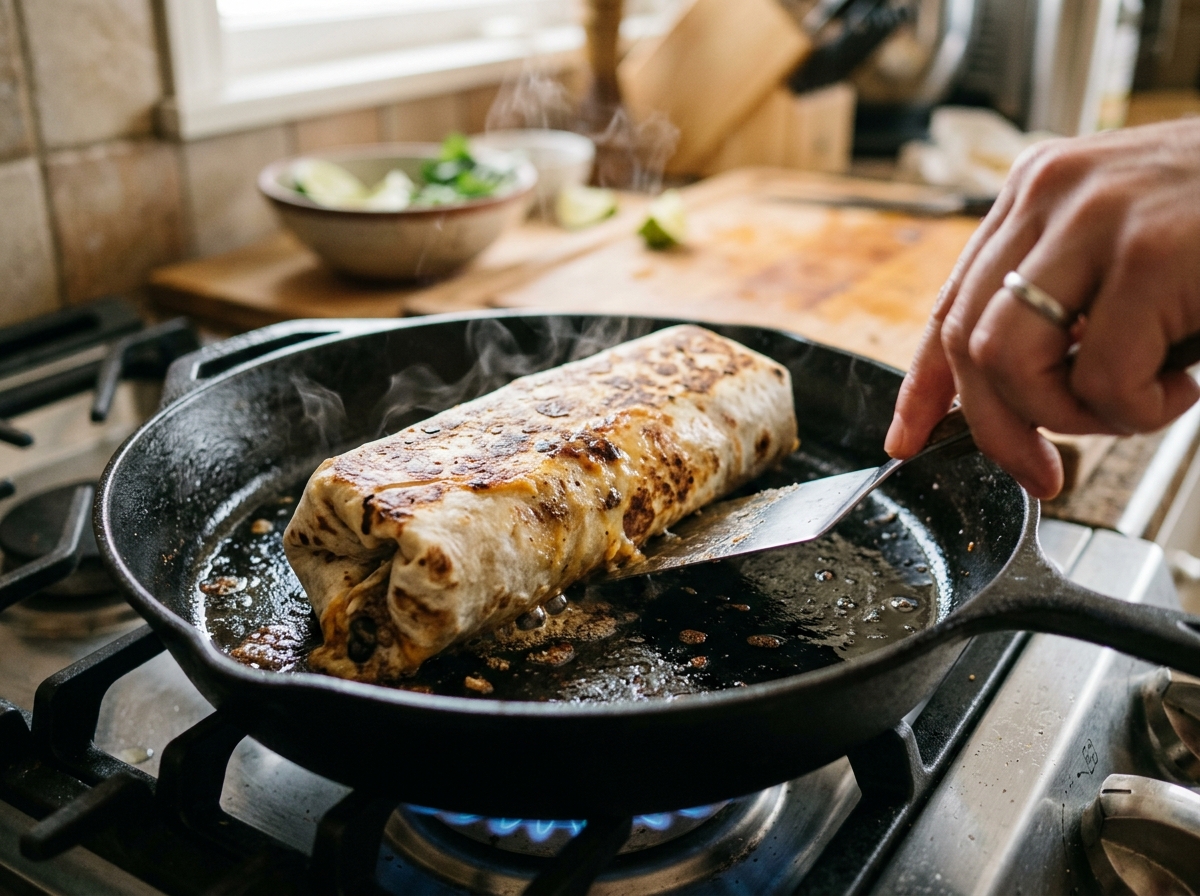
Here’s the best way to do it:
- Heat a nonstick or cast-iron skillet over medium-low heat.
- Put the burrito seam-side down in the dry pan.
- Cover with a lid for 2 to 3 minutes.
- Turn it and heat the other side for 2 to 3 minutes.
- Keep turning until the center feels hot.
The lid helps trap heat so the filling warms while the tortilla browns.
If the burrito is stubbornly cold in the center, add a teaspoon of water to the pan away from the burrito and cover it for about 30 seconds. That little burst of steam helps the inside catch up.
When the skillet works best
The skillet is great for:
- breakfast burritos
- burritos you already microwaved briefly
- smaller homemade burritos
- people who want a toasted tortilla without turning on the oven
A bean and cheese burrito gets especially good in a skillet. The cheese melts, the beans heat through, and the outside gets just enough crisp to feel fresh again.
Small fixes that save a bad reheat
Sometimes the method is fine. The details are what ruin it.
A few small changes can take your burrito from disappointing to pretty solid.
If your burrito keeps drying out
You’re probably using too much direct heat for too long.
Try one of these changes:
- Use lower power in the microwave
- Wrap it in foil in the oven
- Cover the skillet briefly
- Don’t overcook it trying to chase a tiny cold spot
- Let it rest before checking again
A dry burrito usually isn’t underheated. It’s overheated on the outside.
If it keeps turning soggy
Soggy burritos usually come from trapped steam.
To fix that, heat gently at first, then finish with dry heat. That means:
- oven with the foil opened at the end
- microwave first, then skillet
- air fryer finish
Also, watch watery fillings. Salsa, sour cream, tomatoes, and lettuce add moisture fast. If those are tucked inside, the tortilla will absorb some of it during reheating.
If the center stays cold no matter what
That means heat isn’t reaching the middle evenly.
Your best fixes are simple:
- cut the burrito in half
- use lower heat for longer
- flip or rotate it halfway
- avoid very high air fryer heat
- thaw frozen burritos before crisping
People often assume more heat solves everything. With burritos, more heat often just punishes the tortilla.
Adjust for the filling
Not all burritos need the same treatment.
A breakfast burrito with egg and potato reheats well in the microwave plus skillet combo. Eggs can get rubbery if you keep reheating them, so don’t overdo it.
A bean and cheese burrito is forgiving. Almost any method works because the filling is soft and even.
A meat-and-rice burrito needs more patience. Rice holds cold in the center, and steak or chicken can dry out if the outside cooks too fast.
A burrito with lettuce, sour cream, or guac is best opened up first. Remove the cold stuff, reheat the rest, then add fresh toppings back.
A smothered burrito with sauce belongs in the oven, covered.
Food safety matters too
This part isn’t exciting, but it matters.
According to USDA food safety guidance, leftovers should reach 165°F in the center when reheated. If you don’t have a food thermometer, make sure the filling is steaming hot all the way through, especially if it contains meat, eggs, or beans.
Keep these basics in mind:
- Refrigerate leftover burritos within 2 hours
- If the room is very hot, that drops to 1 hour
- Eat refrigerated leftovers within 3 to 4 days
- If a burrito smells off, looks strange, or sat out too long, toss it
If you’re ever unsure, don’t talk yourself into it. A new lunch is cheaper than food poisoning.
FAQ Section
What is the best way to reheat a burrito without making it soggy?
The best way is to heat the burrito gently, then finish with dry heat. For most leftovers, microwave it at 50% power until the center is almost hot, then crisp it in a skillet or air fryer. If you have more time, the oven at 350°F gives an even reheat with less sogginess.
Can you reheat a burrito in the microwave and still keep it crispy?
Yes, but not with the microwave alone. The microwave is good for warming the filling fast, but it softens the tortilla. If you want a crispy outside, microwave the burrito just long enough to heat the center, then toast it in a skillet or air fryer for a couple of minutes.
How long does it take to reheat a frozen burrito?
It depends on size and method. A frozen burrito often takes about 35 to 45 minutes in a 350°F oven, 12 to 15 minutes in an air fryer, or several minutes in the microwave. The best texture usually comes from microwaving it briefly to thaw the center, then finishing it in the oven, air fryer, or skillet.
Should you thaw a frozen burrito before reheating?
You don’t have to, but it helps. Thawing the burrito overnight in the fridge, or microwaving it for a minute or two first, makes it easier to heat the center evenly. That lowers the risk of a burnt tortilla and a cold middle.
Can you reheat a burrito with sour cream, lettuce, or guacamole inside?
You can, but the texture usually won’t be great. Lettuce wilts, sour cream can separate, and guacamole can get messy. If possible, open the burrito, remove those cold toppings, reheat the hot fillings, and add fresh toppings back at the end.
Is it safe to reheat a burrito more than once?
It’s safer and better for quality to reheat only the portion you plan to eat. Reheating the same burrito again and again can dry it out and raise food safety concerns if it cools down slowly between rounds. Reheat it once until the center reaches 165°F, then eat it.
Conclusion
If you’re short on time, the microwave will get the job done. If you want the burrito to taste closer to fresh, the oven, air fryer, or skillet will treat it much better. Pick the method based on the burrito you actually have, not just the clock on the wall.
Next time you’ve got a leftover burrito staring at you from the fridge, don’t just blast it and hope. A couple of smarter minutes can turn it into a lunch you’ll actually enjoy.