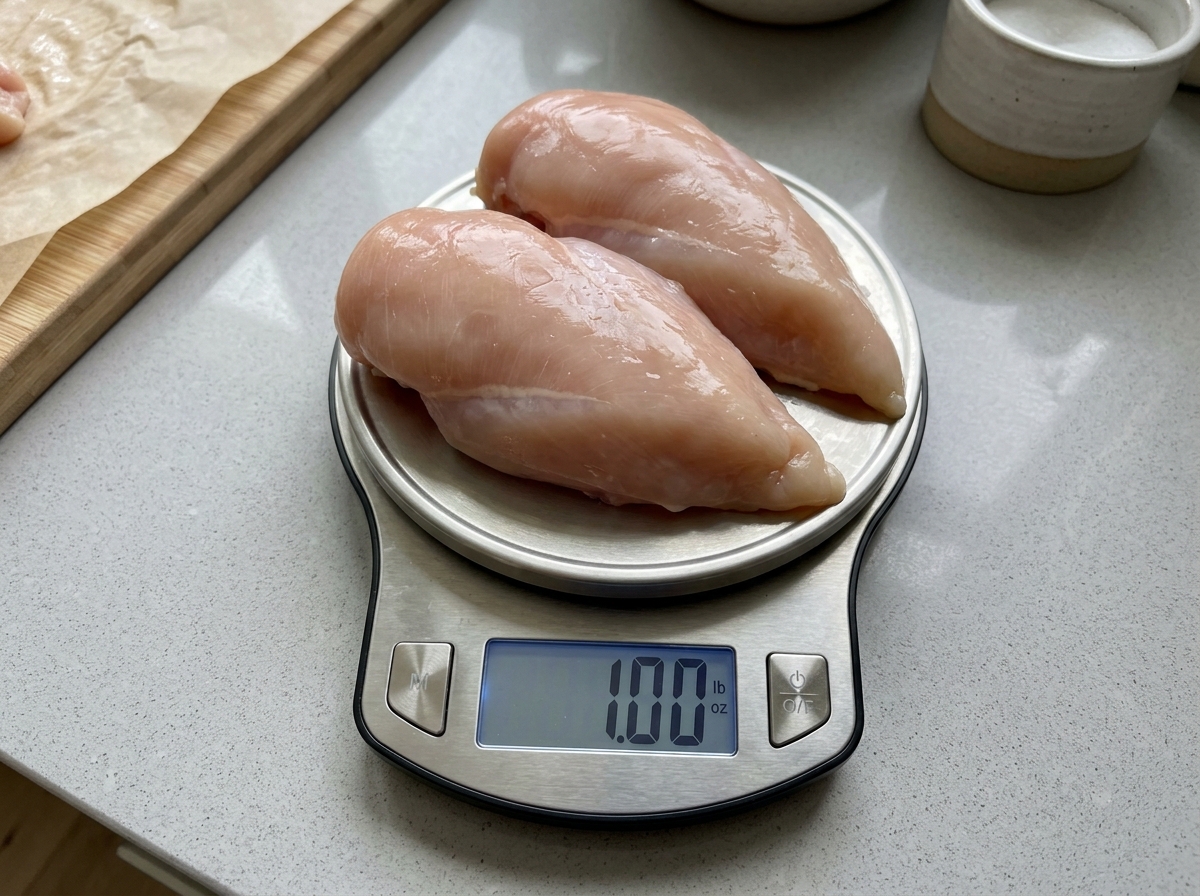
If you’re buying boneless, skinless chicken breasts, 1 pound usually equals 2 medium chicken breasts.
That’s the quick answer most people need.
But chicken breasts don’t all weigh the same, so the real range looks like this:
| Chicken breast size | Average weight per piece | About how many in 1 pound |
|---|---|---|
| Small | 5 to 6 oz | 3 |
| Medium | 7 to 8 oz | 2 |
| Large | 9 to 12 oz | 1 to 2 |
| Bone-in, skin-on split breast | 10 to 14 oz | About 1 |
So if you’re standing in the grocery store asking, “How many chicken breasts are in a pound?” the safest everyday answer is 2 medium breasts.
Quick fact: 1 pound = 16 ounces = 454 grams.
That little bit of math makes the whole topic much easier.
If each breast weighs 8 ounces, you get 2 per pound. If each one weighs 6 ounces, you get closer to 3. If they’re oversized 10-ounce pieces, you may only get 1 full breast plus part of another pound.
That’s why recipes that say “use 2 chicken breasts” can feel vague. Two small breasts and two jumbo breasts can be very different in weight, cooking time, and serving size.
How much does one chicken breast weigh?
Boneless, skinless chicken breast weight
A typical boneless, skinless chicken breast from a U.S. grocery store often weighs between 6 and 8 ounces. That’s why 2 medium breasts usually make a pound.
Still, “typical” doesn’t mean “always.”
Some smaller packs have breasts closer to 5 ounces each, especially if they’re trimmed neatly or labeled as thinner cutlets. Family packs often contain much larger pieces, and those can hit 9, 10, or even 12 ounces each.
That’s one reason people get confused online. A recipe writer may picture two 6-ounce breasts. You may be holding two 11-ounce ones. Same number of pieces. Very different amount of chicken.
Did you know? A lot of modern supermarket chicken breasts are big enough to count as two servings, not one.
Bone-in chicken breasts weigh more
If you’re buying bone-in, skin-on split chicken breasts, the count changes fast.
The bone and skin add weight, so 1 pound may equal only 1 piece, sometimes a little more if the pieces are small. But that doesn’t mean you’re getting a full pound of meat you can eat. Part of that weight is bone.
So if your recipe calls for 1 pound of chicken breast meat, don’t swap in 1 pound of bone-in breasts and expect the same result. You’ll end up short.
Why chicken breast size varies so much
A few things change the weight:
- how the chicken was processed
- whether the breast is boneless or bone-in
- how much trimming was done
- whether the pack contains cutlets or full breasts
- the store’s packaging style
You’ll see this a lot at big supermarkets, warehouse clubs, and butcher counters. Two packs may both weigh 2 pounds, but one has 3 large breasts and the other has 5 smaller ones.
That’s why weight matters more than piece count.
How many chicken breasts do you need for common pound amounts?
This is the part people usually need while shopping.
If you’re using medium boneless, skinless chicken breasts, here’s a simple guide:
| Total weight needed | Approximate number of medium breasts |
|---|---|
| 1/2 pound | 1 |
| 1 pound | 2 |
| 2 pounds | 4 |
| 3 pounds | 6 |
| 4 pounds | 8 |
| 5 pounds | 10 |
That works well if each breast weighs around 8 ounces.
If your chicken breasts are smaller, you’ll need more pieces. If they’re larger, you’ll need fewer.
Real shopping examples
Let’s make this practical.
You need 2 pounds of chicken breast for meal prep. If the breasts in your cart look average sized, expect about 4 pieces.
You need 3 pounds for a party tray or batch cooking. You’ll likely need 6 medium breasts.
You’re buying a family pack with 5 breasts and the label says 2.4 pounds. Divide 2.4 pounds by 5 and each breast averages a little under 8 ounces. That’s a very normal size.
Now imagine another pack with 3 breasts that weighs 2.2 pounds. Those pieces are much larger, around 11 to 12 ounces each. One breast from that pack could easily serve two people after slicing.
How much chicken breast per person?
A lot of people asking about pounds are really trying to answer a different question: How much should I buy per person?
For most meals, a good rule is:
- 6 to 8 ounces raw chicken breast per adult for a main dish
- 4 to 6 ounces raw per person for salads, pasta, tacos, soups, or casseroles where chicken is mixed with other ingredients
That means 1 pound of raw boneless, skinless chicken breast usually feeds 2 to 3 people, depending on the meal.
If you’re making grilled chicken with sides, 1 pound may feel right for 2 adults.
If you’re making chicken Alfredo, burrito bowls, or a chopped salad where chicken is mixed in, that same pound might stretch to 3 people.
Raw vs cooked chicken breast: why the number can feel different
This part trips people up all the time.
A pound of raw chicken breast does not stay a pound after cooking.
Chicken loses weight as it cooks
Chicken breast contains a lot of water. As it cooks, some of that moisture leaves the meat. That means the final cooked weight is lower than the raw weight.
A common rule is that chicken breast loses about 20% to 25% of its weight during cooking.
So if you start with 1 pound raw, you’ll usually end up with roughly 12 ounces cooked.
That matters if your recipe asks for:
- cooked shredded chicken
- cooked diced chicken
- meal-prep portions by cooked weight
- nutrition tracking after cooking
Common misconception: If a recipe needs 1 pound of cooked chicken, you can buy 1 pound raw.
You can’t. You’ll come up short.
If your recipe calls for cooked chicken
Here’s the easy buying rule:
If you need 1 pound cooked chicken breast, buy about 1.25 to 1.5 pounds raw.
That little cushion helps cover moisture loss and trimming.
If you’re cooking for a casserole, enchiladas, chicken salad, or soup, this saves you from the annoying moment where the pan is ready but the chicken amount isn’t.
How many cups of chicken is in a pound?
People ask this a lot because many recipes use cups, not pounds.
For 1 pound of raw boneless, skinless chicken breast, you’ll usually get about:
- 2 1/2 cups chopped cooked chicken, or
- about 3 cups shredded cooked chicken
The exact amount depends on how small you cut it and how tightly you pack the cup.
Shredded chicken takes up more space because it’s looser. Diced chicken sits tighter in the cup.
So if a recipe asks for 2 cups shredded chicken, 1 pound raw is usually enough.
If it asks for 4 cups shredded chicken, buy closer to 1 1/2 to 2 pounds raw, depending on breast size and how fine you shred it.
The easiest way to estimate chicken at the store
You don’t need to guess. You just need one small habit: shop by weight, not by pieces.
Read the net weight first
Every package gives you a net weight. Start there.
If the label says 1.0 lb, you know the whole pack contains 16 ounces total. Then glance at the number of pieces.
Two pieces in a 1-pound pack? They average about 8 ounces each.
Four pieces in a 1-pound pack? They’re quite small, around 4 ounces each.
Three pieces in a 2-pound pack? They’re large, close to 10 to 11 ounces each.
That one quick look tells you a lot.
Use simple ounce math
You don’t need a calculator unless you want to be exact.
Just remember a few common sizes:
- 4 oz each = 4 breasts per pound
- 6 oz each = about 3 breasts per pound
- 8 oz each = 2 breasts per pound
- 10 to 12 oz each = 1 to 2 breasts per pound
If you can estimate the size of one piece, the rest gets easy.
Big chicken breasts? Split them
Some chicken breasts look huge because they are huge.
A 10- to 12-ounce chicken breast often cooks better if you butterfly it, slice it into cutlets, or cube it for stir-fry. It also gives you better portion control.
That’s useful for recipes that call for “2 chicken breasts.” Two giant breasts can overwhelm a dish that was written for medium ones.
Pro tip: If you cook chicken often, keep a cheap kitchen scale at home. After you weigh chicken a few times, your eyes get much better at estimating size in the store.
Watch the label words
“Chicken breast fillets,” “thin sliced,” “cutlets,” and “split breast” can all mean slightly different things.
- Thin sliced or cutlets are usually lighter and cook faster.
- Full boneless breasts are thicker and heavier.
- Split breasts usually mean bone-in, skin-on pieces.
If you only look at the number of pieces and ignore those label terms, your recipe can go sideways fast.
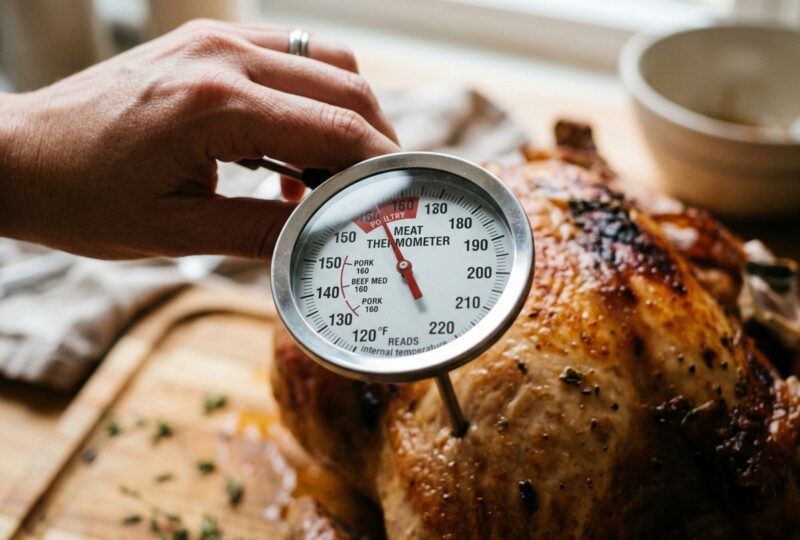
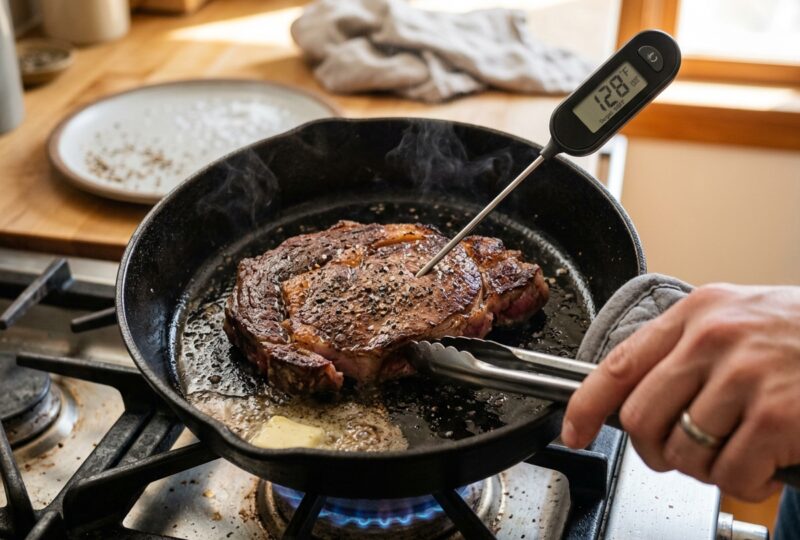
Warning: For food safety, cook chicken to 165°F (74°C) in the thickest part. A food thermometer beats guessing every time. If you follow special diet or health advice, use guidance from USDA, FDA, or your doctor or dietitian.
Common mix-ups that throw off your recipe
A lot of the confusion around how many chicken breasts in a pound comes from a few very normal mistakes.
Mixing up raw weight and cooked weight
You buy 1 pound raw. You cook it. Now it weighs less. That’s normal.
If you meal prep by cooked ounces, don’t expect four 4-ounce cooked portions from one raw pound every time. You may end up a bit short.
Treating one breast as one serving
That used to be a safer assumption years ago, but store sizes now vary a lot.
A small 5-ounce breast can be one serving. A large 11-ounce breast can be two servings once cooked and sliced.
If you’re counting protein or planning portions, weigh the meat instead of trusting the piece count.
Forgetting that bone-in breasts give less meat
This catches people during sales. Bone-in chicken breasts often cost less per pound, so they look like a bargain. They can be. But if your recipe needs a measured amount of meat, part of that pound is bone and skin.
For roasting, bone-in is great. For exact recipe math, boneless is easier.
Assuming every recipe means the same breast size
One cookbook says “use 2 chicken breasts.” A food blog says the same thing. A YouTube video says “grab 3 breasts.” None of them may tell you the weight.
That’s why weight-based recipes are easier to trust. If a recipe only gives you a piece count, use these rough checks:
- 2 medium breasts = about 1 pound
- 4 medium breasts = about 2 pounds
- 1 large breast may be 1/2 to 3/4 pound by itself
Confusing tenderloins with chicken breasts
Chicken tenderloins are the small strip attached to the underside of the breast. They’re not the same size as full chicken breasts.
A pound of tenderloins gives you many more pieces than a pound of full breasts. So if you swap them, don’t use the same piece count.
How to plan chicken breast for common meals
This is where the weight question becomes useful in real life.
For tacos, wraps, and bowls
Chicken gets mixed with rice, tortillas, beans, veggies, or toppings, so you usually need less per person.
For 4 people, 1.5 to 2 pounds raw boneless skinless chicken breast is usually enough.
If your store has medium pieces, that means about 3 to 4 breasts.
For grilled chicken dinners
If chicken is the star of the plate with just sides, aim a bit higher.
For 4 adults, buy about 2 pounds raw, or around 4 medium breasts.
If the breasts are very large, you may only need 3 and then slice them after cooking.
For soup, pasta, casseroles, and chicken salad
These dishes stretch the meat more.
For many family-style recipes, 1 to 1.5 pounds raw works well. That’s often 2 to 3 medium breasts.
If the recipe asks for shredded chicken, remember that 1 pound raw usually gives you about 3 cups shredded cooked chicken.
For meal prep
A lot of people portion chicken into containers for the week.
Let’s say you want five meals with about 4 ounces cooked chicken in each. That’s 20 ounces cooked total. Since chicken loses weight during cooking, you’ll want roughly 1.75 to 2 pounds raw.
That usually means 4 medium breasts, sometimes 5 small ones.
That kind of planning feels fussy the first time. After you do it once, it gets very easy.
- FAQ Section
Frequently Asked Questions
How many chicken breasts are in 1 pound?
For boneless, skinless chicken breasts, 1 pound usually equals 2 medium breasts. If the breasts are small, you may get 3 per pound. If they’re very large, you may get 1 to 2.
Is one chicken breast a pound?
Usually, no. Most boneless skinless chicken breasts weigh about 6 to 8 ounces, so one piece is often less than a pound. Very large supermarket breasts can weigh 10 to 12 ounces, but even those are still often under a full pound.
How many chicken breasts are in 2 pounds?
If the breasts are medium size, 2 pounds is usually 4 chicken breasts. If they’re small, it may be 5 or 6. If they’re large, it may be 3.
How many cups of chicken is 1 pound?
One pound of raw boneless skinless chicken breast usually gives about 2 1/2 cups chopped cooked chicken or around 3 cups shredded cooked chicken. The exact amount depends on how you cut or shred it.
Does cooked chicken weigh less than raw chicken?
Yes. Chicken breast usually loses about 20% to 25% of its weight while cooking because moisture cooks out. So 1 pound raw often becomes about 12 ounces cooked.
How much chicken breast should I buy per person?
For a main dish, plan about 6 to 8 ounces raw chicken breast per adult. For mixed dishes like pasta, soup, tacos, or salad, 4 to 6 ounces raw per person often works well.
- Conclusion
The easiest way to answer how many chicken breasts in a pound is this: most of the time, it’s 2 medium boneless, skinless breasts. Still, size matters more than piece count, and that’s why one pack can look totally different from the next.
Your best next step is simple. Check the weight on the label first, then use the breast count as a rough guide. Do that a couple of times, and you’ll stop guessing whether you have enough for dinner, meal prep, or that recipe waiting on your phone.