If you just want the fast answer, here it is.
| Lasagna type | Covered bake time | Uncovered bake time | Total time at 350°F |
|---|---|---|---|
| Freshly assembled, standard 9×13 pan | 40–50 min | 10–15 min | 50–65 min |
| Refrigerated lasagna | 55–70 min | 10–15 min | 65–85 min |
| Frozen lasagna, thawed overnight | 60–75 min | 10–15 min | 70–90 min |
| Frozen lasagna, baked from solid frozen | 75–90 min | 15–20 min | 90–110 min |
| Smaller 8×8 lasagna | 35–45 min | 10 min | 45–55 min |
Those times work for most homemade lasagnas baked in a conventional oven at 350°F.
Still, don’t treat the clock like the boss. Lasagna is done when the center is hot, the sauce is bubbling, and the noodles feel tender. If your lasagna started cold, is packed with layers, or sits in a deep dish, it may need more time.
Quick fact: A deep, heavy lasagna can look done on top and still need another 10 to 20 minutes in the middle.
Why bake time changes so much
One recipe says 45 minutes. Another says 75. So what’s going on?
The biggest reason is simple: not every lasagna starts in the same state.
Starting temperature matters most
A lasagna you just assembled with warm sauce is very different from one you pulled straight from the fridge. The first one only needs to bake. The second one needs to heat through from the center out.
Think of it like warming a thick winter coat. The outside warms fast. The inside takes longer.
If your lasagna is:
- Freshly assembled, it usually bakes faster.
- Refrigerated overnight, expect to add 15 to 25 minutes.
- Frozen, the time jumps a lot, especially if it’s still solid.
If you make lasagna ahead, you can set it on the counter for about 20 to 30 minutes before baking. That won’t fully warm it up, but it gives you a small head start. Just don’t leave it out too long. Food safety still matters.
Thickness changes the clock
A thin lasagna with three layers cooks much faster than a tall, bakery-style pan stacked with five or six layers.
More layers mean more mass. More mass means more time for heat to reach the center.
That’s why a deep lasagna in a ceramic or glass baking dish can run well past the time printed in a quick recipe card.
Your pan makes a difference too
Pan material changes how heat moves.
- Metal pans heat faster.
- Glass pans heat more slowly but hold heat longer.
- Ceramic dishes often bake a bit gently and evenly, but they can take extra time in the center.
You don’t need to overthink it. Just know that the same lasagna may bake a little faster in a light metal 9×13 pan than in a thick ceramic dish.
Warning: If you’re using a glass baking dish, avoid sudden temperature changes. A very cold glass dish going straight into a hot oven can be risky. Always check the dish maker’s care instructions.
The type of noodles matters
Regular boiled noodles, oven-ready noodles, and homemade pasta sheets don’t behave the same way.
Oven-ready noodles often need enough sauce and enough covered time so they can soften properly. If your lasagna seems dry or the noodles stay chewy, lack of moisture may be the issue, not just bake time.
Fresh pasta sheets usually soften faster. Dry no-boil noodles need more help from the sauce.
How to bake lasagna at 350 step by step
A lot of people don’t really need a recipe. They need a solid method. Here’s the easiest one to trust.
Freshly assembled lasagna at 350
For a standard 9×13 homemade lasagna that you assembled the same day, plan on 50 to 65 minutes total.
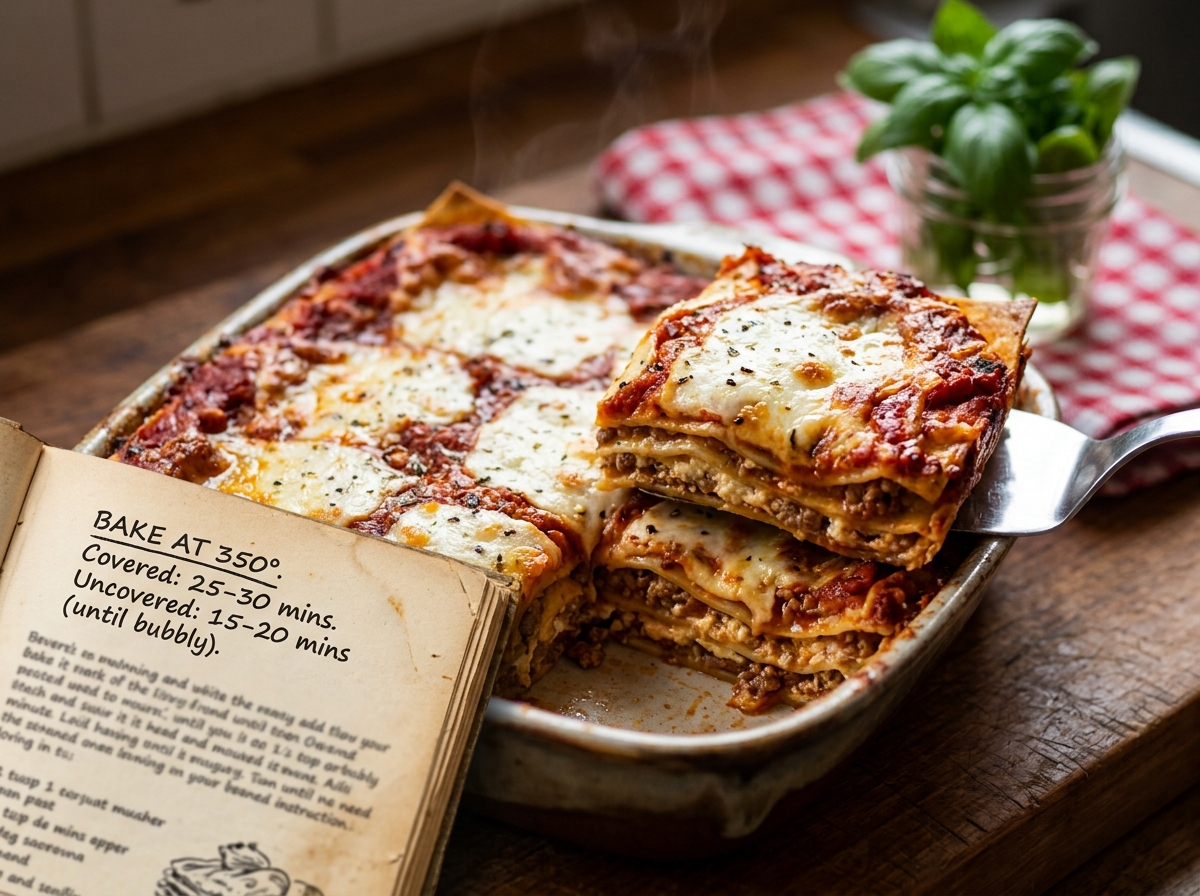
Start by covering the pan with foil. Bake it covered for 40 to 50 minutes. Then uncover it and bake for another 10 to 15 minutes so the cheese can brown and the top can set.
If your sauce and meat were still a bit warm from the stove, you may land closer to the low end. If the lasagna is thick and packed, it may need the full time.
A classic example: you make a meat lasagna with ricotta, mozzarella, meat sauce, and regular noodles. You assemble it, let it sit while the oven finishes preheating, then bake it. That kind of lasagna usually lands around 55 to 60 minutes at 350°F.
Refrigerated lasagna at 350
If your lasagna was made ahead and chilled, you’ll need more patience.
A refrigerated lasagna usually needs 65 to 85 minutes total at 350°F. Keep it covered for most of the bake, around 55 to 70 minutes, then uncover it for 10 to 15 minutes.
Why so long? The cold center takes time to catch up.
If you’re cooking for guests, this is the version that throws dinner off schedule the most. People see bubbling edges, assume it’s ready, and cut in too early.
Use the center as your test point, not the corners.
Pro tip: Spray the underside of the foil with a little cooking spray. That keeps melted cheese from sticking to the foil and pulling your top layer apart.
Frozen lasagna at 350
Frozen lasagna brings two very different timing paths.
If it’s thawed overnight in the fridge, expect about 70 to 90 minutes total. Keep it covered for most of that time, then uncover it near the end.
If it’s still fully frozen, you’re usually looking at 90 to 110 minutes, sometimes longer for a very thick pan or a store-bought family-size tray.
The center matters even more here. A frozen lasagna can have lava-hot edges and a cold middle. That’s not done.
If the top starts getting too dark before the center is ready, put the foil back on loosely and keep baking.
Should you bake lasagna covered or uncovered?
Start covered. Finish uncovered.
Covering the pan traps steam, which helps heat the center and soften the noodles. Uncovering near the end helps the cheese brown and lets extra surface moisture cook off.
A good rhythm is simple:
- Bake covered for most of the time
- Bake uncovered for the last 10 to 15 minutes
If your cheese is already browned the way you like, you don’t have to uncover for the full 15 minutes. Use your eyes.
How to tell when lasagna is done
A timer helps. Your senses help more.
Look for bubbling in the center, not just the edges
Many people check the edges and stop there. That’s the trap.
The corners always heat faster. You want to see the middle area hot and active, not just sauce bubbling around the rim.
If the top is nicely browned but the center looks quiet, give it more time.
Test the center with a thermometer
The most reliable check is an instant-read thermometer.
Insert it into the center of the lasagna. For chilled, frozen, or reheated lasagna, aim for 165°F in the middle. That lines up with common USDA guidance for casseroles and leftovers.
For a fresh homemade lasagna assembled with already-cooked meat and hot sauce, many cooks still use 160 to 165°F as a practical target because it tells you the center is fully heated and the layers have set.
You don’t need to poke five holes in it. One check in the middle does the job.
Use the knife test too
No thermometer nearby? Slide a thin knife into the center and hold it there for a few seconds. Pull it out and touch the blade carefully. It should feel very hot.
You can also check how the knife moves. It should pass through tender noodles without much resistance.
If the middle feels firm or cool, keep baking.
Let it rest before cutting
This part gets skipped all the time, and then people blame the recipe.
Lasagna needs a rest of at least 10 to 15 minutes after baking. A very full pan can rest for 20 minutes and still be hot.
That short wait does two big things:
It lets the layers settle, and it helps the slices hold their shape.
Cut too soon and you’ll get a cheesy landslide. Tasty? Sure. Neat? Not even close.
Did you know? A lasagna often looks firmer and slices better after a 15-minute rest than it did the moment it came out of the oven.
Common mistakes that throw off bake time
Lasagna isn’t hard, but a few small mistakes can add time or hurt the final texture.
Trusting the recipe time more than the pan in front of you
Recipe times are based on one setup: one oven, one pan, one thickness, one starting temperature.
Your oven may run cool. Your lasagna may be deeper. Your ingredients may be colder.
So if a recipe says 50 minutes and your center is still not hot, that doesn’t mean you messed up. It means your lasagna needs more time.
Skipping the foil at the start
If you bake a thick lasagna uncovered from the start, the top can dry out before the center finishes heating.
That often leads to two problems at once: burned cheese and undercooked middle.
Foil keeps moisture in during the part of baking that matters most.
Using too little sauce
Dry lasagna often bakes poorly. The noodles need moisture. The whole dish needs steam.
If you skimp on sauce, the noodles may stay too firm, especially with no-boil noodles. Then you keep baking longer, the cheese gets darker, and the pan still doesn’t feel right.
A good lasagna should look a little saucier before it goes into the oven than you think it needs. It tightens up as it bakes.
Cutting into it right away
This doesn’t change the oven time, but it changes the result so much that it deserves a spot here.
Fresh from the oven, lasagna is loose and bubbling. Give it time to settle. You’ll get cleaner slices and better texture.
Real-world timing examples
General advice is nice. Real examples are better.
Example 1: Standard 9×13 meat lasagna
You make a classic meat lasagna with cooked ground beef, marinara, ricotta, mozzarella, parmesan, and regular noodles. The sauce is warm. The pan is full but not sky-high.
Bake it covered for 45 to 50 minutes, then uncover for 10 to 15 minutes.
That puts your likely total around 55 to 65 minutes, followed by a 15-minute rest.
This is the most common answer people are looking for when they search how long to bake lasagna at 350.
Example 2: Make-ahead lasagna from the fridge
You assembled the same lasagna the night before and kept it in the refrigerator.
Now you’re starting cold. Bake it covered for 60 to 70 minutes, then uncovered for 10 to 15 minutes.
Your total will likely land around 70 to 85 minutes, then a 15-minute rest.
If the center still isn’t hot, don’t panic. Add another 10 minutes and check again.
Example 3: Small 8×8 lasagna
Maybe you’re cooking for two to four people, not a crowd.
A smaller 8×8 lasagna often bakes in 45 to 55 minutes total at 350°F. Covered for most of the time, uncovered at the end.
Smaller pans cook faster because the center doesn’t sit as far from the heat.
Example 4: Frozen store-bought lasagna
Store-bought frozen lasagna varies a lot by brand, tray size, and whether the package wants you to bake it from frozen or thawed.
A small frozen tray may finish in around 75 to 90 minutes at 350°F. A large family-size tray can take 90 minutes or more.
Here’s the safe rule: follow the package first, then verify the center is hot. Package directions are built around that product’s size and ingredients.
If you’re changing the oven temperature from what the box says, expect the timing to change too.
350 vs 375: which is better?
A lot of lasagna recipes use 375°F, so it’s fair to ask if 350°F is too low.
It isn’t too low. It’s just gentler.
At 350°F, lasagna bakes more slowly and evenly. That can help if your oven browns the cheese fast or if you’re baking a thick pan.
At 375°F, the total bake time is usually shorter, but the top may darken faster. Some cooks like that. Some don’t.
If your goal is a steady, forgiving bake, 350°F works very well. You just need to allow enough time.
What if you’re using a convection oven?
Convection ovens move hot air around, so food often cooks faster.
If you’re using convection, start checking your lasagna 5 to 10 minutes earlier than the standard times above. Some ovens also suggest lowering the heat by 25°F for baked dishes.
Every oven has its own personality, so treat those as starting points, not hard rules.
4. FAQ Section
FAQ
How long should I bake lasagna at 350 covered?
For most lasagnas, bake covered for 40 to 70 minutes, depending on whether it’s fresh or refrigerated. Freshly assembled lasagna usually needs 40 to 50 minutes covered. Refrigerated lasagna often needs 55 to 70 minutes covered. Then uncover it for the last 10 to 15 minutes.
How long do I bake refrigerated lasagna at 350?
A refrigerated lasagna usually takes 65 to 85 minutes total at 350°F. Bake it covered for most of that time, then uncover it near the end so the cheese can brown. Check the center before serving.
How long do I bake frozen lasagna at 350?
If the lasagna is thawed first, plan on 70 to 90 minutes total. If it’s still frozen solid, it often needs 90 to 110 minutes, sometimes more for a large tray. Keep it covered for most of the bake, and make sure the center is fully hot before you take it out.
Do you bake lasagna at 350 covered or uncovered?
Both, just at different stages. Start covered so the middle heats through and the noodles soften. Finish uncovered for the last 10 to 15 minutes so the top browns and sets.
How do you know when lasagna is done in the middle?
Look for bubbling in the center, not just at the edges. A knife should slide in easily, and the middle should feel very hot. The best test is an instant-read thermometer. For chilled, frozen, or reheated lasagna, aim for 165°F in the center.
Can you overbake lasagna at 350?
Yes, you can. If it stays in too long, the edges can dry out, the cheese can get too dark, and the noodles can turn overly soft. That’s why it helps to keep the pan covered for most of the bake and uncover it only near the end.
Should lasagna rest before cutting?
Yes. Let it rest for 10 to 15 minutes, or even 20 minutes for a very full pan. Resting helps the layers set, so your slices hold together better.
5. Conclusion
If you want the simplest answer, fresh lasagna at 350°F usually takes 50 to 65 minutes, refrigerated lasagna needs longer, and frozen lasagna needs the most time. Start covered, uncover near the end, and trust the center more than the clock.
If you’re baking one tonight, your best next step is easy: check the middle with a thermometer or knife before you pull it out. That one small habit saves you from the classic “brown top, cold center” problem—and gets you the kind of lasagna people actually remember.