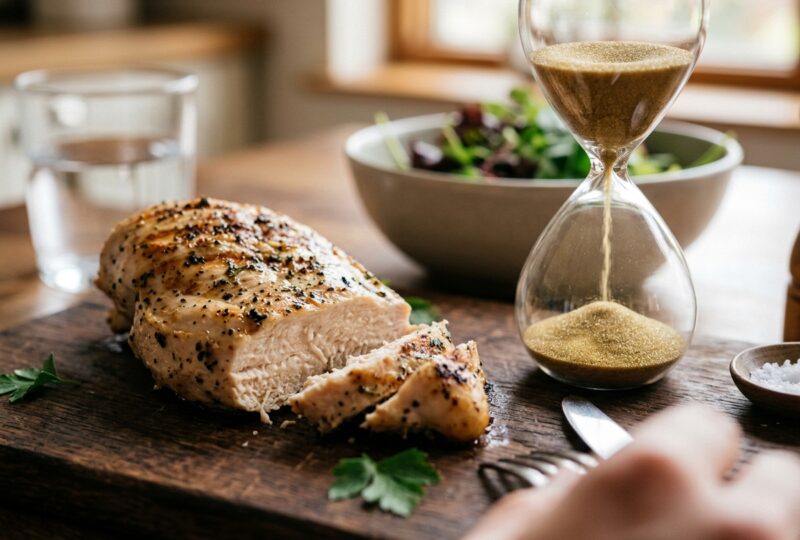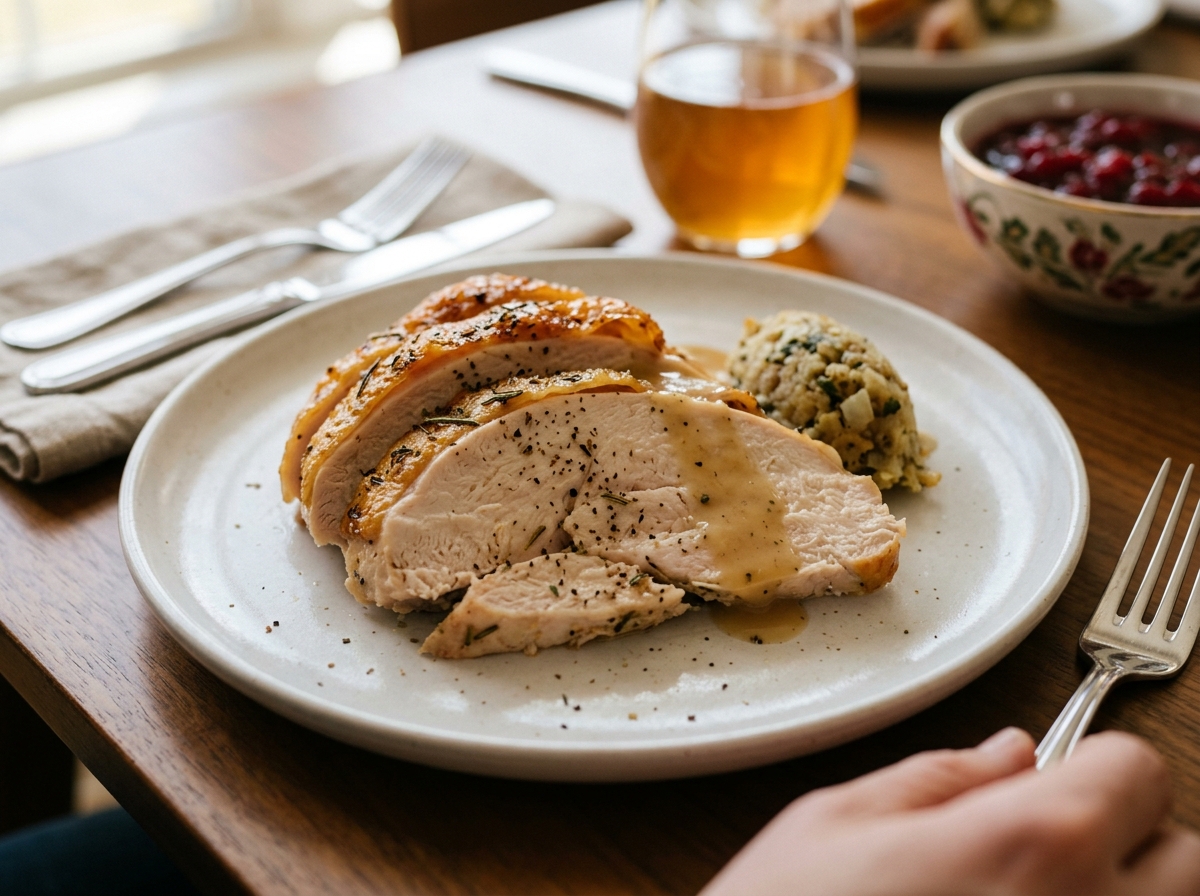
Here’s the short answer most people want right away.
For a normal meal with side dishes, plan on:
| Turkey breast type | Buy this much per person | Best for |
|---|---|---|
| Boneless turkey breast | 1/2 pound raw per person | Regular dinner with sides |
| Bone-in turkey breast | 3/4 pound raw per person | Regular dinner with sides |
| Boneless turkey breast with leftovers | 3/4 pound raw per person | Sandwiches, meal prep, second helpings |
| Bone-in turkey breast with leftovers | 1 pound raw per person | Holiday meals and next-day leftovers |
That’s the easiest rule to remember. If you stop reading here, you’ll still be in good shape.
But the reason people get confused is simple: turkey breast doesn’t always mean the same thing. A boneless turkey breast roast and a bone-in turkey breast don’t give you the same amount of edible meat, even if the package weight looks similar.
Quick rule for boneless turkey breast
A boneless turkey breast is the easiest one to plan.
For most adults, 1/2 pound raw per person works well if you’re serving stuffing, mashed potatoes, green beans, rolls, pie, and all the usual holiday food. After cooking, that usually gives a satisfying portion without a pile of waste.
If turkey is the main star and you want extra slices for lunch the next day, go up to 3/4 pound per person.
A good way to think about it? Boneless turkey breast is like buying trimmed fruit. Most of what you pay for ends up on the plate.
Quick rule for bone-in turkey breast
A bone-in turkey breast needs a little more room in the math.
Plan on 3/4 pound raw per person for a regular meal. If you want leftovers, use 1 pound per person.
Why more? Because part of that weight is bone, and some moisture cooks off in the oven. So a 6-pound bone-in turkey breast does not give you 6 pounds of sliced turkey.
Did you know? The package weight on turkey is always raw weight, not the amount you’ll carve and serve.
How much cooked turkey breast per person?
If you’re buying cooked sliced turkey breast from a deli, caterer, or prepared foods counter, the math changes a bit.
For cooked turkey breast, serve:
- 5 to 6 ounces per adult for a regular dinner
- 7 to 8 ounces per adult if turkey is the main focus or you want hearty portions
That’s useful if you’re not roasting at home and need to order by the pound.
Since 1 pound = 16 ounces, one pound of cooked turkey breast feeds about:
- 2 to 3 adults for a regular meal
- 2 adults if you want generous servings
So yes, the raw and cooked numbers are different. That’s where a lot of portion mistakes begin.
Why how much turkey breast per person changes by meal
A simple formula helps, but your table matters just as much as the numbers.
A quiet Sunday dinner for four is not the same as Thanksgiving with cousins, two teenagers, and a guy who always asks, “Any more of that turkey?”
Side dishes change the turkey amount
If your meal includes lots of filling sides, people usually eat less meat.
Think about a classic Thanksgiving table: stuffing, mashed potatoes, gravy, sweet potatoes, cranberry sauce, mac and cheese, dinner rolls, and dessert. In that setup, 1/2 pound boneless or 3/4 pound bone-in per person usually works very well.
Now picture a simpler dinner with turkey breast, one vegetable, and maybe a salad. People will lean harder on the turkey. In that case, it makes sense to buy about 25% more.
So the more side dishes you serve, the less turkey each person usually needs.
Adults, kids, and big eaters aren’t equal
One common mistake is counting every guest the same way.
That sounds fair, but it doesn’t work in real life.
Most young kids won’t eat an adult-sized turkey portion. Many older adults won’t either. On the other hand, hungry teens, athletes, and big eaters can easily clear more than one standard serving.
A simple way to count guests:
- 1 adult = 1 portion
- 1 child under 10 = 1/2 portion
- 1 big eater = 1 1/4 portions
That one small adjustment can save you from buying way too much or coming up short.
Leftovers change the plan more than anything else
If you want turkey for sandwiches, soups, casseroles, or meal prep, don’t rely on the standard serving rule.
Add more from the start.
For leftovers, use:
- 3/4 pound boneless per person
- 1 pound bone-in per person
Why so much? Because leftovers disappear faster than people expect. A few slices for dinner, a sandwich or two the next day, maybe turkey fried rice or turkey noodle soup, and suddenly that “extra” roast is gone.
If your family loves leftovers, buy for the next meal too, not just tonight’s plate.
How much turkey breast per person for common group sizes
If you don’t want to do any math, use this chart.
The lower end works for a normal meal with side dishes. The higher end gives you extra for seconds or leftovers.
| Number of people | Boneless turkey breast | Bone-in turkey breast |
|---|---|---|
| 4 | 2 to 3 pounds | 3 to 4 pounds |
| 6 | 3 to 4.5 pounds | 4.5 to 6 pounds |
| 8 | 4 to 6 pounds | 6 to 8 pounds |
| 10 | 5 to 7.5 pounds | 7.5 to 10 pounds |
| 12 | 6 to 9 pounds | 9 to 12 pounds |
| 15 | 7.5 to 11 pounds | 11 to 15 pounds |
| 20 | 10 to 15 pounds | 15 to 20 pounds |
Here’s how to read that chart in real life.
If you’re feeding 8 adults at Thanksgiving and the table is loaded with sides, a 4 to 5 pound boneless turkey breast is usually enough.
If you’re feeding 8 adults and want leftovers for lunch, buy about 6 pounds boneless or 8 pounds bone-in.
For 10 people, a 5-pound boneless roast might work for a lighter crowd with plenty of side dishes, but 7 to 7.5 pounds is safer if your guests are hungry or you want leftovers.
Pro tip: If your final number lands in the middle, round up. Nobody complains about extra turkey nearly as much as they complain about not enough.
Boneless vs bone-in turkey breast: which is easier to plan?
A lot of portion confusion starts right here.
The words sound similar, but the planning is different.
Bone-in turkey breast gives flavor, but less edible meat
Bone-in turkey breast can be juicy and flavorful. Many people love it for holiday meals because it looks more traditional and often cooks up beautifully.
But from a planning point of view, bone-in is trickier.
Part of the package weight is bone. Then you lose some moisture while roasting. That means the amount you carve and serve is noticeably less than the label suggests.
So if you see a 7-pound bone-in turkey breast, don’t think of it as seven pounds of dinner meat. Think of it as a roast that will feed around 7 to 9 people, depending on sides and leftovers.
Boneless turkey breast makes portioning easier
Boneless turkey breast is easier to buy, carve, and serve.
The math is cleaner. The slices are easier to cut. Storage is simpler. If you’re feeding a small group or don’t want extra stress, boneless is often the better choice.
For example, if you need dinner for 6 adults, buying a 3 to 4 pound boneless turkey breast is a pretty low-stress move. With bone-in, you’d want more like 4.5 to 6 pounds.
That’s a big difference at the store.
Common misconception: whole turkey rules don’t always fit turkey breast
A lot of online advice uses the rule for a whole turkey, which is often 1 to 1.25 pounds per person.
That rule works for a bird with wings, legs, thighs, and a full skeleton.
It does not transfer neatly to turkey breast.
Turkey breast has a different meat-to-bone ratio, especially if you buy boneless. So if you’ve ever used whole-turkey math for a turkey breast roast and ended up with too much meat, that’s probably why.
How to calculate the exact amount for your table
If you want a number that actually fits your meal, use this simple method.
The easy formula
Start by counting portion units, not just heads.
Count them like this:
- Adults = 1
- Kids under 10 = 0.5
- Big eaters = 1.25
Then multiply by:
- 0.5 pound each for boneless turkey breast
- 0.75 pound each for bone-in turkey breast
If you want leftovers, bump that up to:
- 0.75 pound each for boneless
- 1 pound each for bone-in
That’s it.
No fancy calculator needed.
Real example: family dinner for 6 adults and 2 kids
Let’s say you have:
- 6 adults
- 2 children under 10
Count the kids as one adult total.
So your portion count is 7.
For a normal meal with sides:
- Boneless: 7 × 0.5 = 3.5 pounds
- Bone-in: 7 × 0.75 = 5.25 pounds
In real shopping terms, you’d buy:
- 4 pounds boneless, or
- 5.5 to 6 pounds bone-in
That little bit of rounding protects you from cooking loss and uneven trimming.
Real example: 10 adults, big eaters, and planned leftovers
Now let’s say you’re feeding 10 adults, two of them are big eaters, and you want turkey sandwiches tomorrow.
Your portion count becomes:
- 8 regular adults = 8
- 2 big eaters = 2.5
Total = 10.5 portions
For leftovers:
- Boneless: 10.5 × 0.75 = 7.875 pounds
- Bone-in: 10.5 × 1 = 10.5 pounds
That means you should buy roughly:
- 8 pounds boneless, or
- 10.5 to 11 pounds bone-in
Now the numbers actually match your crowd.
Real example: cooked turkey breast from a deli
Let’s say you don’t want to roast. You’re ordering sliced turkey breast from a deli for 4 adults.
Use 5 to 6 ounces cooked per person.
So you need:
- 4 × 5 ounces = 20 ounces
- 4 × 6 ounces = 24 ounces
That’s 1.25 to 1.5 pounds of cooked turkey breast.
If you want leftovers, order closer to 2 pounds.
Warning: Always ask whether the shop is quoting raw weight or cooked weight. Those numbers are not interchangeable.
Buying, thawing, cooking, and storing turkey breast without waste
Portioning is only half the battle. A good buy can still go sideways if the roast is too big to thaw in time or dries out in the oven.
Buy a size you can cook evenly
Bigger is not always better.
A very large turkey breast can take longer to thaw, longer to cook, and may cook unevenly. The outside can dry out before the center is done.
For larger groups, two smaller roasts often work better than one giant one. That gives you:
- faster thawing
- easier seasoning
- more even cooking
- simpler carving
For example, two 3-pound boneless turkey breasts are often easier to handle than one 6-pound roast.
Thawing and cooking basics
If your turkey breast is frozen, the USDA’s refrigerator thawing rule is a good one to remember: allow about 24 hours for every 4 to 5 pounds.
So a 5-pound turkey breast may need about a full day in the fridge. A larger one may need longer.
For cooking, many turkey breasts roast well at 325°F (163°C). A rough estimate is 20 to 25 minutes per pound, but time varies by shape, whether it’s bone-in, and whether it starts very cold.
The safest move is simple: use a meat thermometer.
Cook turkey breast until the thickest part reaches 165°F (74°C).
Then let it rest for 15 to 20 minutes before slicing. Resting helps the juices settle, and your slices stay moister.
Store leftovers safely
Holiday meals stretch on, and turkey often sits out longer than it should.
For food safety, refrigerate cooked turkey within 2 hours. If the room is very hot, do it sooner.
You can store leftovers:
- in the fridge for 3 to 4 days
- in the freezer for 2 to 6 months for best quality
If someone in your home is pregnant, older, or has a weaker immune system, be extra careful with temperature and storage.
A little planning here saves money and avoids waste.
One last mistake to avoid
Don’t judge the roast by package weight alone.
A labeled 6-pound bone-in turkey breast and a labeled 6-pound boneless turkey breast are not equal in edible meat. That’s probably the single biggest reason people buy the wrong amount.
If you remember only one thing, remember that.
4. FAQ Section
FAQ
How much turkey breast per person for a holiday meal?
For a holiday meal with plenty of sides, plan on 1/2 pound of boneless turkey breast per person or 3/4 pound of bone-in turkey breast per person. If you want leftovers, go up to 3/4 pound boneless or 1 pound bone-in per person.
How much cooked turkey breast should I serve per person?
For cooked turkey breast, serve about 5 to 6 ounces per adult for a regular dinner. If turkey is the main focus or you want bigger portions, serve 7 to 8 ounces per person.
Is 1 pound of turkey breast enough for 2 people?
Yes, 1 pound of boneless turkey breast is usually enough for 2 adults if you’re serving side dishes and don’t need leftovers. If your guests are big eaters or you want extra for sandwiches, buy more.
How much bone-in turkey breast do I need for 8 adults?
For 8 adults, buy about 6 pounds of bone-in turkey breast for a standard meal with sides. If you want leftovers, buy closer to 8 pounds.
Should children count as full portions?
Usually, no. A simple rule is to count young children as half a portion. Teenagers can eat like adults, and sometimes more, so count them as full portions.
Can I use whole turkey serving rules for turkey breast?
Not exactly. Whole turkey rules often suggest 1 to 1.25 pounds per person, but that includes legs, thighs, wings, and more bone. Turkey breast has a different yield, so it’s better to use 1/2 pound boneless or 3/4 pound bone-in as your starting point.
5. Conclusion
If you want the easiest answer, stick with this: buy 1/2 pound of boneless turkey breast per person or 3/4 pound of bone-in turkey breast per person for a normal meal. Add more if your crowd is hungry or your real goal is tomorrow’s sandwiches.
Before you shop, count kids as half portions, decide if you want leftovers, and round up if you’re between sizes. That small bit of planning makes the whole meal feel easier. And honestly, extra turkey is a much nicer problem than not enough.