For most home cooks, this is the answer you need right away:
Boneless, skinless chicken breast at 350°F usually takes 25 to 30 minutes if each piece is about 6 to 8 ounces and roughly 1 inch thick.
That’s the sweet spot most people are looking for.
If you’re baking other types, the time changes a bit:
| Type of chicken breast | Usual size/thickness | Bake time at 350°F | Safe internal temp |
|---|---|---|---|
| Thin sliced cutlets | about 1/2 inch | 15 to 20 minutes | 165°F / 74°C |
| Small boneless, skinless | 5 to 6 oz | 20 to 25 minutes | 165°F / 74°C |
| Medium boneless, skinless | 6 to 8 oz, about 1 inch | 25 to 30 minutes | 165°F / 74°C |
| Large boneless, skinless | 8 to 12 oz | 30 to 35 minutes | 165°F / 74°C |
| Bone-in split chicken breast | larger, thicker | 35 to 45 minutes | 165°F / 74°C |
| Frozen boneless breast* | varies | 40 to 50+ minutes | 165°F / 74°C |
*Frozen chicken can be baked safely, but thawed chicken usually cooks more evenly and stays juicier.
The number to trust most is not the timer. It’s 165°F in the thickest part, which is the food safety standard recommended by the USDA.
A lot of articles stop at “25 to 30 minutes” and leave it there. That’s where people get tripped up. Two chicken breasts can weigh the same and still cook at different speeds. One might be wide and flat. The other might be thick like a paperback book. Same weight, very different bake time.
Quick Facts
- 25 to 30 minutes is the usual range for medium boneless breasts at 350°F
- Thickness matters more than weight
- 165°F is the safe internal temperature
- Rest for 5 to 10 minutes before slicing
Did you know? A thick 8-ounce breast can take 8 to 10 minutes longer than a flatter 8-ounce breast. That’s why so many “exact time” recipes still give dry results.
What changes the baking time?
A recipe can give you a solid starting point, but chicken breast isn’t a cookie. It doesn’t bake the exact same way every time. A few small details change everything.
Thickness matters more than weight
This is the biggest one.
Let’s say you bought two 8-ounce chicken breasts. One is thin and spread out. The other is short and chunky. The thick one will need more time because the heat has to travel farther to reach the center.
Think of it like warming bread versus warming a baked potato. Both can weigh the same, but the thicker one takes longer because the middle stays cooler longer.
That’s why many cooks gently pound chicken breasts to an even thickness before baking. You don’t need to flatten them paper-thin. Just even them out so one end isn’t much fatter than the other.
Bone-in vs boneless
A bone-in chicken breast takes longer than a boneless chicken breast at 350.
The bone affects how heat moves through the meat, and bone-in breasts are usually larger to begin with. You’ll often need 35 to 45 minutes, sometimes a bit more for very large pieces.
Boneless, skinless breasts are faster and more common for weeknight dinners, meal prep, salads, wraps, and rice bowls. That’s why the 25 to 30 minute range gets searched so often.
Fresh, thawed, or frozen
If your chicken is fully thawed, the times above work well.
If it’s still frozen, the clock changes a lot. At 350°F, frozen chicken breast can take 40 to 50 minutes or longer, depending on thickness and size. It’s safe if you cook it all the way to 165°F, but it’s not always the best texture.
Thawing in the fridge gives you more even results. The outside won’t dry out while the middle catches up.
Your oven matters more than you think
Some ovens run hot. Some run cool. Some say 350°F and act more like 365°F. Others are sleepy and take their sweet time.
That’s not you doing anything wrong. That’s just real life in home kitchens.
A cheap oven thermometer can save a lot of guesswork. So can an instant-read thermometer for the chicken itself.
Convection ovens also cook a bit faster because the hot air moves around more. If you use convection, start checking a few minutes early.
The pan and setup can change things
A dark metal sheet pan can brown chicken faster than a glass baking dish. Crowding the pan can also slow things down because the heat can’t move around each piece as well.
If you place four large breasts shoulder-to-shoulder in a small dish, they’ll usually take longer than the same pieces baked with space between them.
Little details like this explain why two people follow the “same recipe” and still get different results.
How to bake chicken breast at 350 so it stays juicy
Timing is only half the story. You also want chicken that tastes good, slices well, and doesn’t need extra sauce just to go down.
Here’s a simple method that works for most boneless, skinless chicken breasts.
A simple step-by-step method
- Preheat your oven to 350°F.
Let it fully preheat before the chicken goes in. Starting in a half-warm oven throws off the timing. - Pat the chicken dry.
Dry surface = better texture and better seasoning. Use paper towels. - Even out thick pieces if needed.
If one end is much thicker, gently pound it with a meat mallet, rolling pin, or even a heavy pan. You’re not smashing it. You’re just helping it cook evenly. - Rub with a little oil and season well.
Olive oil or avocado oil works well. Salt, black pepper, garlic powder, paprika, onion powder, or Italian seasoning are all easy wins. - Place the breasts in a baking dish or on a sheet pan with space between them.
Don’t pack them too tightly. - Bake based on size, then check the temp.
Start checking at the lower end of the time range. For medium boneless breasts, that means around 25 minutes. - Rest for 5 to 10 minutes before slicing.
Resting helps the juices settle back into the meat instead of running onto the cutting board.
That’s it. No fancy trick. No secret chef move. Just good timing, even thickness, and the right finish temp.
Covered or uncovered at 350?
Most of the time, bake chicken breast uncovered.
Uncovered chicken gets better color and a nicer surface. Covered chicken traps steam, so it stays softer on the outside and won’t brown much.
If your chicken breasts are especially thin, or if you’re baking them in a sauce, a loose foil cover can help keep them from drying out. Still, for plain seasoned chicken breast, uncovered is usually better.
A real-life weeknight example
Let’s say you have two boneless, skinless chicken breasts that each weigh around 7 ounces.
You pat them dry, add oil, salt, pepper, garlic powder, and paprika, then place them on a parchment-lined sheet pan.
At 350°F, those will usually take around 26 to 29 minutes. You check the thickest part with an instant-read thermometer. Once it hits 165°F, you pull them out and rest them for 7 minutes.
Now you’ve got juicy slices for pasta, sandwiches, salad, or meal prep bowls.
That’s the kind of result people want when they search this topic. Not just “how long,” but “how long without ruining dinner.”
Pro tips that actually help
A few small habits can make a big difference:
- Salt the chicken 15 to 30 minutes early if you have time
- Use an instant-read thermometer instead of guessing
- Don’t skip the rest time
- Pound very uneven breasts so one end doesn’t dry out
- Start checking early, especially with smaller pieces
One extra trick? A quick dry brine works really well. Just season the chicken with salt a little ahead of time and let it sit in the fridge. That gives the salt time to work into the meat, which helps with flavor and moisture.
You don’t need a long marinade to make baked chicken breast good. You need control.
How to tell when chicken breast is done
This is where many people slip. The chicken looks done. The top has color. The juices seem clear. So out it comes.
Then you slice it and the center is still undercooked. Or worse, you leave it in “just to be safe” and end up with dry meat.
Use a thermometer, not just the clock
The best way to know chicken breast is done is to check the internal temperature.
Insert an instant-read thermometer into the thickest part of the breast, without touching bone if there is one.
You want the center to reach 165°F (74°C).
That one number clears up a lot of confusion.
A timer gives you a range. A thermometer gives you the answer.
Where should you check the temperature?
Don’t poke the very thin tip of the breast. That part cooks faster and can fool you.
Aim for the thickest middle section. If the breast is uneven, check more than one spot.
This matters even more with larger family-pack chicken breasts, which are often much thicker on one side.
What visual signs help?
Visual signs can help, but they shouldn’t be your only test.
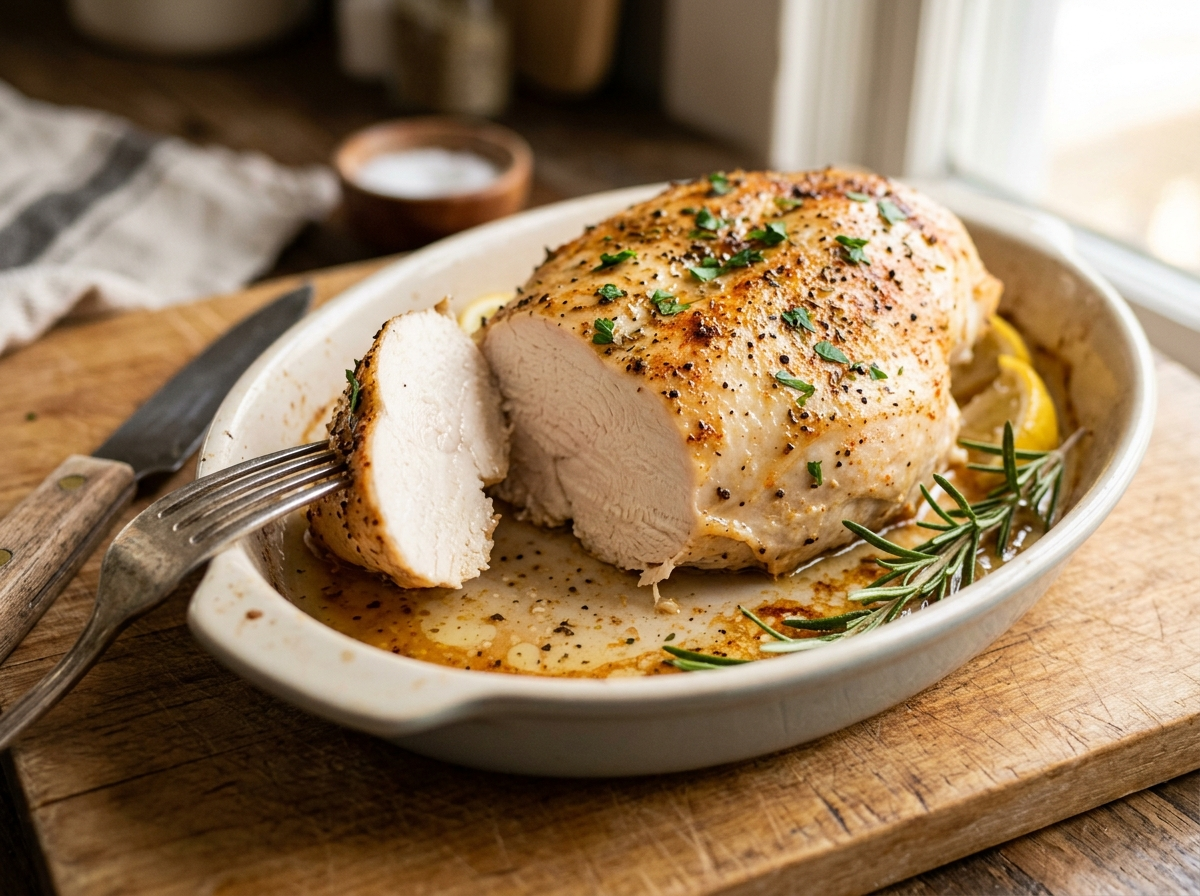
Cooked chicken breast should look:
- opaque, not glossy or raw-looking
- white throughout, though some slight pink can happen near bone
- firm but still a little springy
Clear juices can be a clue, but they’re not a guarantee. Color alone can mislead you.
Warning: “The juices ran clear” is not a reliable food safety test. 165°F is.
What if it’s a little under?
No need to panic.
If the center reads 158°F to 162°F, put it back in the oven for a few more minutes and check again. At 350°F, small jumps happen quickly near the end.
On the other hand, if you leave it in until 175°F or 180°F, the texture gets much firmer and drier. That’s the cardboard zone most people are trying to avoid.
Let it rest before slicing
Resting for 5 to 10 minutes after baking helps the meat hold onto more juice.
Cut it right away and the juices run out onto the board. Let it rest and more of that moisture stays in the chicken.
It’s the same reason steak rests. Meat needs a minute to settle down.
Common mistakes that make baked chicken breast dry
Chicken breast is lean. That’s part of why people like it. It’s also why it dries out faster than thighs.
The good news? Most dry chicken comes from a few easy-to-fix habits.
Relying on time alone
A recipe says 30 minutes, so you bake it for 30 minutes. Sounds reasonable, right?
The problem is that your chicken may be smaller, thinner, or larger than the recipe writer’s chicken. Your oven may also run hotter.
That’s why time should be your guide, not your final answer.
Skipping the thickness fix
A breast that’s thin on one end and thick on the other cooks unevenly. By the time the thick side reaches 165°F, the thin side may already be overcooked.
A quick pound to even it out can solve that fast.
If you only remember one prep trick from this article, make it this one.
Cutting into it too early
People do this to “check if it’s done,” but it lets the juices escape.
Use a thermometer instead. Then let it rest. You’ll lose less moisture and get cleaner slices too.
Thinking low heat always means juicy chicken
A common misconception is that 350°F automatically protects chicken from drying out.
It doesn’t.
350°F is forgiving, not magic. Leave chicken breast in too long and it still dries out. A gentle oven helps, but time still matters.
Crowding the pan
When chicken pieces are packed too close together, they don’t roast as evenly. Airflow drops, and the surface can steam instead of lightly browning.
Give each piece a little breathing room.
Ignoring carryover cooking
Chicken can keep rising a bit after it comes out of the oven, especially larger pieces. That’s one reason resting matters.
Some experienced cooks pull chicken just before 165°F and let it finish during the rest. If you’re newer to cooking, it’s easier to aim for 165°F in the thickest part, then rest it.
Using giant chicken breasts without adjusting
Large supermarket chicken breasts can be much thicker than the average recipe expects. If yours are closer to 10 to 12 ounces each, don’t assume the 25-minute mark will be enough.
Start checking around 30 minutes instead.
Did you know? Many of the “chicken breast recipes” that feel unreliable are really just using chicken breasts of very different sizes without saying so.
4. FAQ Section
FAQ
How long do you bake boneless skinless chicken breast at 350?
Most boneless skinless chicken breasts bake at 350°F for 25 to 30 minutes if they are medium-sized, about 6 to 8 ounces each and roughly 1 inch thick. Smaller pieces may finish in 20 to 25 minutes, while larger ones can need 30 to 35 minutes. Always check that the center reaches 165°F.
Do you bake chicken breast covered or uncovered at 350?
For plain seasoned chicken breast, bake it uncovered. That gives you better color and a better surface texture. Covering traps steam, so the chicken stays softer on top and won’t brown much. If you’re baking in sauce or trying to protect very thin pieces, a loose foil cover can help.
Is 350 a good temperature for chicken breast?
Yes, 350°F is a good temperature for chicken breast, especially if you want a gentle, forgiving bake. It usually gives you juicy results if you don’t overcook it. Some cooks prefer 400°F or 425°F for faster cooking and more browning, but 350°F works very well for everyday baking.
Can you bake frozen chicken breast at 350?
Yes, you can bake frozen chicken breast at 350°F, but it takes longer. Expect around 40 to 50 minutes or more, depending on size and thickness. For better texture and more even cooking, thaw the chicken in the fridge first. Frozen chicken should still reach 165°F in the center before you eat it.
Why is my baked chicken breast dry even when I followed the recipe time?
The most common reasons are uneven thickness, larger chicken breasts than the recipe used, an oven that runs hot, or not checking the internal temperature early enough. Chicken breast can go from juicy to dry fast. Using an instant-read thermometer and resting the meat after baking makes a big difference.
How long to bake thin chicken breast at 350?
If your chicken breast is thin-sliced or pounded to around 1/2 inch thick, it can bake in 15 to 20 minutes at 350°F. Start checking early. Thin chicken cooks fast and can dry out before you realize it.
What temperature should chicken breast be when done?
Chicken breast should reach 165°F (74°C) in the thickest part to be safely cooked. That’s the standard home-cooking target recommended by the USDA. A digital instant-read thermometer is the easiest way to know for sure.
5. Conclusion
If you want the simple answer, here it is: most chicken breasts bake at 350°F in 25 to 30 minutes. The better answer is to use that time as your starting point, then check for 165°F in the thickest part.
That one habit changes everything.
Next time you bake chicken breast, don’t play the guessing game. Check the thickness, start early, use a thermometer, and give it a short rest. You’ll get chicken that’s juicy, safe, and actually worth making again.