If you’re wondering where to probe a brisket, you’ve come to the right place. Probing helps you monitor internal temperature, so you can tell whether or not the brisket is done. It also helps you determine if it’s tender.
How to Probe Brisket?
When it comes to cooking brisket, there are a few things you need to know. Brisket is a fatty cut of meat, so it must be cooked slowly over low heat to prevent it from becoming dry or tough. A thermometer is the best way to know when your brisket is cooked to your desired level.
The best way to probe a brisket is to hold the thermometer horizontally and angle it across the grain. The point will not give as accurate a read because of its fat content and connective tissue. You should also make sure the brisket is properly rested before cooking, as a tired brisket will cook more slowly. Finally, make sure to use a quality brisket rub if you choose to do so.
Where to Probe Brisket?
One of the most important aspects of grilling a brisket is knowing where to probe. You want to probe the thickest part of the meat, which is not always the center. You must look at the brisket from a distance to find this point. This distance will help you identify the thickest part of the brisket without touching it. Secondly, you need to know how deep to insert the probe. Once you have the depth of the probe, push it down to the center point of the brisket. This point will have the coldest temperature.
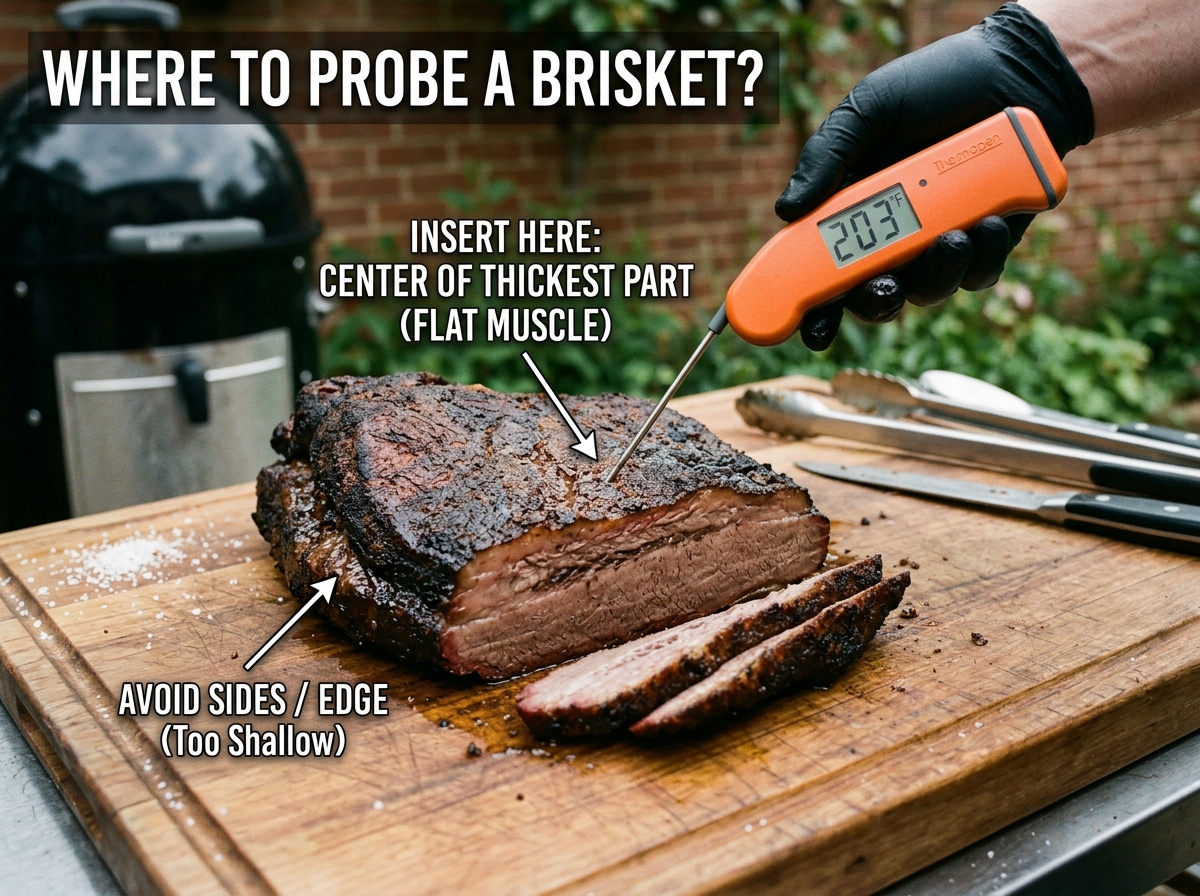
The best place to insert the probe is across the thickest part of the flat. This will provide the most accurate temperature readings and help you judge whether the brisket is cooked to your liking. However, you must note that the point part of the brisket finishes cooking faster than the flat part, which will give you inaccurate temperatures.
Where to Probe Brisket: The Point or The Flat?
One of the most important aspects of grilling a brisket is knowing where to probe. You want to probe the thickest part of the meat, which is not always the center. You must look at the brisket from a distance to find this point. This distance will help you identify the thickest part of the brisket without touching it. Secondly, you need to know how deep to insert the probe. Once you have the depth of the probe, push it down to the center point of the brisket. This point will have the coldest temperature.
The best place to insert the probe is across the thickest part of the flat. This will provide the most accurate temperature readings and help you judge whether the brisket is cooked to your liking. However, you must note that the point part of the brisket finishes cooking faster than the flat part, which will give you inaccurate temperatures.
Probing the Flat
When you probe a brisket, you should probe near where these two muscles meet – this occurs at the thickest point of the flat muscle. This is the spot where the brisket muscle meets the Internal Fatty Layer.
The flat muscle is the most important muscle in a brisket. It’s responsible for the overall shape and texture of the brisket. This thin and flat muscle makes it one of the most difficult muscles to probe.
Probing the flat muscle is especially important when cooking a brisket. The brisket will be dry and tough if you don’t probe the flat muscle.
When cooking a brisket, it’s important to keep the flat muscle intact. The brisket will be dry and tough if you don’t probe the flat muscle. By probing the flat muscle, you can ensure that the brisket is cooked evenly and properly.
Probing the Point
The best place to probe a brisket is right in the middle of the densest part of the flat. You should insert the thermometer horizontally and angle it across the grain. The point will not give as accurate a read because of its fat content and connective tissue. The probe should be inserted at least 2 inches below the surface of the meat.
The brisket is a tough cut of meat that can withstand a lot of cooking. You can cook it slowly over low heat or quickly over high heat. The best way to determine how long to cook it is to probe it and then cook it until the thermometer registers 190 degrees.
Brisket is a versatile cut of meat that can be used in a variety of dishes. It can be used in tacos, enchiladas, and burritos. It can also be used in a braised dish or in a pot roast.
Probing for Tenderness
When it comes to barbecue, there are few things more iconic than a brisket. A big, juicy piece of meat that can be smoked for hours over wood or coals, brisket is a culinary classic. But just what is it that makes a brisket so tender?
When it comes to brisket, there are a few things that are key:
- The meat should be cooked slowly over low heat so that it doesn’t become tough.
- It should be sliced thinly so that the meat can cook evenly and not be dried out.
- It’s important to use a good brisket rub to add flavor and tenderness.
A few briskets rubs on the market will achieve excellent results. My favorite is the KC Masterpiece Brisket Rub. This rub is a combination of spices that give the meat a deep, rich flavor. It’s also very tenderizing, making it a great choice for those looking to achieve a truly succulent brisket.
If you’re looking to try your hand at brisket cooking or want to add a bit of flavor and tenderness to your barbecue repertoire, give the KC Masterpiece Brisket Rub a try. You won’t regret it!
The Difference Between the Flat and The Point
When it comes to brisket, there are two main types: the flat and the point.
The flat brisket is the more common of the two, and it’s generally a thinner cut of meat that’s been trimmed of any excess fat. It’s a good all-purpose brisket that can be used for anything from a sandwich to a plate of barbecue.
The point brisket, in contrast, is a thicker cut of meat that has been trimmed off any excess fat and has a more pronounced point. It’s perfect for brisket tacos, smoked brisket burritos, and brisket steaks.
The point brisket is also easier to manage because it doesn’t have as much fat and connective tissue as the flat brisket. This makes it a better choice for those who are looking to cook a brisket to perfection.
So, which is the better brisket? It really depends on your preferences. The flat brisket is the better option if you’re looking for a good all-purpose brisket. But if you’re looking for a thicker cut of meat that’s perfect for specific dishes, the point brisket is the better option.
How to Measure the Internal Temperature of Brisket
There are several methods for measuring the internal temperature of a brisket. The most accurate method is to insert the probe into the thickest part of the brisket, right next to the point. This way, you can read both the point and the flat simultaneously. It’s important to make sure that the probe is inserted at an angle to the meat, not across it.
However, it’s important to remember that probes inserted in the point are not as accurate as the ones inserted into the flat. The reason is that a point has a lot of connective tissue and fat, so a probe inserted in this area won’t be as accurate as those in the flat.
Place the thermometer in the thickest part of the brisket.
The brisket’s ideal spot to place a thermometer is the thickest part. It will not be as accurate if you place it in the leaner areas. The probe should be in the thickest part of the meat, where it will not touch the surface fat.
The brisket should be tender when a bamboo skewer or toothpick is inserted into it. The temperature should be around 185 degrees F. If you can’t reach this temperature, you may want to continue cooking it for a few hours more.
Place a meat thermometer in the thickest part of the brisket and use it to probe it. Make sure not to get the thermometer stuck in the fat, as this can cause inaccurate readings. Make sure the probe is about halfway into the brisket. Analog meat thermometers are the most common and simplest to use.
When you’re cooking a brisket for a crowd, you’ll want to ensure that you cook it to the proper temperature. While an experienced cook can tell by sight, most people will need to use a meat thermometer to get the right result.
The thickest part of the brisket is usually not in the middle, so you should place the thermometer in the thickest part. If the thermometer isn’t accurate, you’ll have to look at it from a distance. This will make it easier to identify the thickest part of the brisket. It’s also advisable to know how deep to push the probe into the brisket since the center will have the lowest temperature.
Once you’ve reached the desired temperature, you can start slicing the brisket. If you can’t get your hands on a thermometer, you can try the probe test, which involves using a toothpick or knife to poke the meat. The meat should be soft, chewy, and sticky, but it should not be dry or too hard to cut.
Check temperature every 30 minutes
Checking the temperature of brisket is crucial to achieving the right texture and color. You can use an instant-read thermometer to test its internal temperature. The meat is done when it is at least 195 degrees F. When it reaches this temperature, you can start to see the rich, dark bark.
Most brisket recipes call for a temperature of 185-195 degrees Fahrenheit, but this temperature may vary depending on the recipe. Some recipes may call for 190-200 degrees. Either way, stopping the meat at 195 degrees will produce a flavorful and tender brisket.
If you’re using a barbecue, you can use a remote meat probe. This will help maintain a consistent temperature inside the smoking chamber. It will also help prevent the bark from drying out. After briskets reach this temperature, you can wrap them in towels and let them rest for two to four hours. To add moisture, lightly mist the surface with water or beef broth. Apple juice can also be used to moisten the meat.
Briskets typically have a moderate amount of fat. You’ll need a boning knife or filet knife to cut the fat. It’s important to remember that briskets may have different fat pockets. The flat side should be trimmed first. It should also be free of silver skin.
While briskets are typically cooked slowly, following the correct temperature is critical to ensure optimal tenderness. When cooking briskets, the meat needs to remain at a temperature of at least 160 degrees Fahrenheit.
Avoid the fattier part of the brisket.
The fattier part of the brisket should be avoided when cooking brisket. The fat does not tenderize the meat. Instead, it enables the meat to retain its moist state and flavor. Also, the fat does not penetrate the meat. To avoid this problem, cut the brisket in half before cooking it.
If you are cooking the brisket by yourself, make sure to position the fat side down. This will help prevent the leaner part of the brisket from drying out. In addition, you can wrap the meat halfway through the cooking process to prevent it from drying out.
To cut the brisket, make a long cut to grip the fat. After you’ve cut the meat, make a second, shorter cut parallel to the brisket. This will allow you to keep your left hand free to hold the fat.
Another common mistake smokers make choosing the fattier part of the brisket. These parts do not yield as much meat as the rest of the brisket. In fact, they contain up to 17% more fat than the rest of the meat. So, you should avoid the fattier part if you want to get a leaner cut.
Brisket is one of the most difficult cuts of beef, so choosing the right one is essential. Always check the USDA meat grade label to avoid the worst quality when purchasing your brisket. Purchasing the wrong cut will set you back financially, so make sure you get a high-grade brisket instead.
It is important to choose the right cut for your recipe. The flat brisket is leaner, while the point has more fat and marbling. If you have a family who enjoys lean meat, flat brisket is better for them. It is also more tender than the fattier part. It is also juicy when cooked.
Cleaning a thermometer
Properly cleaning a thermometer is an essential part of meat cooking. Regardless of whether you’re probing a brisket or a turkey, you must disinfect the thermometer. To ensure the safety of your thermometer, you should always clean it with soap and water. After cleaning it, you should rinse it with cool water.
For glass thermometers, you can use cooking spray or food-grade silicon spray to remove tough stains. You’ll also need to rinse the stem thoroughly to remove any soap residue. Then, dry the thermometer well before using it again. You can try white vinegar if you want to clean a probe with a more sensitive material.
When testing your brisket, using a meat probe is the most accurate way to determine doneness. This allows you to check the internal temperature of the brisket and determine whether it’s tender or not. If you don’t use a meat thermometer, you’ll risk under or overcooking the meat.
After using a meat thermometer for several hours, you should clean it. Grease, fat, and other particles can get stuck on the thermometer, making it difficult to read accurately. To avoid this, make sure to clean it regularly after every use. This will prevent the thermometer from malfunctioning and affecting the readout of your meat.
The temperature probe should be thoroughly soaked in water to remove any stubborn bits of meat and grease. You should also use a sponge to scrub the probe’s end with soapy water. Dish soap will cut through grease and remove stubborn bits of meat.
Using a wireless thermometer
If you want to cook a delicious and juicy brisket, then using a wireless thermometer to probe the internal temperature of the meat is a smart idea. A wireless thermometer can eliminate wires and connect via Bluetooth to your phone. It can also display information on the meat and its cooking status via an app, including detailed cooking instructions, time estimates, and more. This feature makes it easy to walk away from the grill while the meat is cooking. In addition, a wireless thermometer is not difficult to use, and it is compact and easy to insert into the meat.
Wireless thermometers are especially useful if you’re cooking in a busy kitchen. You can use a wireless thermometer anywhere there’s a wireless connection. These thermometers are great for grilling, smoking, deep-frying, and sous vide. The Meater probe is 42 inches long, has a stainless steel tip, and is easy to use. The probe is made of high-quality stainless steel material and is able to withstand temperatures between -50 and 300 degrees Fahrenheit. The wireless thermometer also comes with a charger that allows you to recharge the probe.
While a wireless thermometer is a great way to ensure that your brisket is cooked to your satisfaction, you may still want to test its temperature with a traditional thermometer. You should also know the correct way to insert the probe into the brisket for consistent results. This will help you minimize the risk of overcooking the brisket.
It is important to place the probe into the thickest part of the flat part of the brisket. Do not insert the probe at the point of the brisket because it will not give a proper reading because of the connective tissue and fat content. In addition, the temperature probe should be angled across the grain of the meat for a more accurate reading.
Getting Through the Stall
If you’re like most backyard cooks, you’ve probably experienced the dreaded stall. You’ve got your cooker up to a good, steady temperature, and all your ingredients are in the pan and nothing. The meat doesn’t seem to be cooking. You check the temperature, ensure everything is where it should be, and then realize that something is just not right.
The most common culprit in stalls is moisture. Moisture is the enemy of good barbecue. It causes the meat to steam instead of cook, and it can also cause the meat to stick to the cooker or the grill.
One way to combat moisture is to use a water pan. Adding a layer of water to the cooker creates a high-humidity environment. This will help prevent the meat from sticking and create the perfect environment for smoking.
Another way to combat moisture is to spritz your brisket with water from time to time. This will create a mist of water that will help to keep the meat moist and prevent it from sticking to the cooker.
How Deep Do You Insert the Probe?
Do you know how deep to insert the probe of your thermometer when cooking meat? Most thermometers require you to insert the probe at least 1/2 inch into the meat, but if the meat is thicker than an inch, you’ll probably want to go deeper than that to reach the very center.
Here’s a visual guide to help you:
When cooking thick meats like beef or pork, it’s best to insert the probe 1/2 inch into the meat. However, if the meat is thicker than an inch, you’ll probably want to go deeper to get the most accurate reading. For example, if the meat is 3/4 inch thick, you should insert the probe 1 inch into the meat.
If you’re using a thermometer with a digital readout, you can use the probe’s temperature probe to get an accurate reading. Just make sure that the probe is inserted all the way into the meat.
How Often Should I Probe Brisket?
Regarding barbecue, there’s no one right answer – it all depends on the smoker, the meat, and your preference. But one thing that’s sure to be on everyone’s mind is how often to probe the brisket.
There are a few factors to consider when it comes to probing a brisket: the temperature, the thickness of the meat, and the type of smoker.
If you’re using a smoker with a temperature gauge, it’s a good idea to probe the brisket every 30 minutes to ensure the meat is cooking at the correct temperature.
If the meat is too cold, it won’t cook evenly, and it will end up being tough. If the meat is too hot, it’ll cook too quickly, and the juices will evaporate, leaving you with dry brisket.
Brisket is typically very thick, so it can take a little longer to cook than other types of meat. We recommend that you probe the brisket every 45 minutes to ensure it’s cooked through.
And finally, there’s the question of how to probe a brisket. Some people use a fork, while others use a probe. We recommend that you use a probe because it’s more accurate and it’s less likely to puncture the meat.
So, if you’re using a smoker, using a temperature gauge, and cooking your brisket for 3 hours, we recommend probing it every 30 minutes and then again after 45 minutes. And if you’re using a probe, we recommend probing it every 5 minutes.
At What Temperature Is Brisket Done?
Brisket is a popular cut of meat that is typically cooked at a lower temperature than other meats. This is because brisket is relatively lean meat and contains a high amount of connective tissue. This connective tissue is what allows the meat to hold its shape and prevent it from becoming dry.
The typical way to cook brisket is to cook it over an open flame or to use a smoker. These methods allow the brisket to cook quickly and evenly, which results in tender and juicy meat.
The internal temperature of the brisket is 210 degrees Fahrenheit. This temperature is reached after the brisket has been cooked for about three hours over an open flame or using a smoker. (READMORE)
Can You Put a Thermometer Through Butcher Paper?
Wrapping your food in butcher paper can help to keep it fresh and prevent it from getting freezer burn. But is it really necessary?
The short answer is yes, but there are a few caveats. First, if you wrap your food in butcher paper and then put it in the freezer, it’s important to probe the meat before you wrap it to ensure it’s at a safe temperature. If the meat is too cold, the aluminum in the butcher paper can heat up and impact the reading on the probe, so it’s important to probe it before you wrap it.
The other caveat is that if you wrap your food in butcher paper and then put it in the oven, the heat from the oven can cause the butcher paper to expand and create a seal around the food. This can lead to freezer burn. So it’s important to keep an eye on your food while it’s in the oven to make sure that it doesn’t get too hot.
Overall, wrapping your food in butcher paper is a good way to keep it fresh and prevent it from getting freezer burn. Just be sure to probe it before you wrap it, and watch it while it’s in the oven to make sure it doesn’t get too hot.
Where to Put Traeger Probe in A Brisket?
Are you looking to add some extra flavor to your brisket? Traeger has you covered! The Traeger Probe allows you to insert it into the center of your flat, about ½” deep, for some amazing, unique smoked flavor. Not to mention, it helps to keep your brisket evenly cooked from all sides, allowing for even more deliciousness. So, where should you put the Traeger Probe in your brisket? Let us know in the comments below!
How to Tell when Brisket Is Tender?
When it comes to barbecue, there are a few things you can always trust: the juicy, smoke-infused brisket flavor and the meat’s tenderness. And when those two things are working together in harmony, you can be assured that you’re in for a real treat.
There are a few easy ways to tell when the brisket is ready to be served. The first is to use a fork to slide it right into the meat – if it goes right in with no resistance, the brisket is ready. If it still feels a bit tough after being sliced, it may need a little more time in the smoker.
But if all goes well, you can be sure that you’re in for a succulent, tender slice of brisket that will leave you wanting more. So fire up the grill, get that brisket ready to go, and enjoy!
What Type of Probe to Use?
It’s that time of year again – time to cook some delicious barbecue! While there are many different ways to cook this classic American dish, one key factor is getting the temperature just right.
One popular way to cook brisket is by smoking it. Smoking is a great way to add flavor and moisture to the meat, but it can also be difficult to get the temperature just right. That’s where a smart thermometer comes in handy.
Smart thermometers are digital devices that can be inserted into the meat to measure the temperature. They are particularly useful for smoking brisket, as they can quickly and easily tell you if the meat is too hot or too cold.
Instant-read thermometers are also a good option for cooking brisket. These thermometers have a quick read time, so they don’t need to be inserted very far into the meat. They are also easy to use, so you don’t need to worry about reading the temperature correctly.
Which kind of thermometer is best for your barbecue? It’s up to you! But be sure to use a smart thermometer if you’re cooking brisket, as it will help you get the temperature just right.
The Best Tools to Use for Probing
When cooking a brisket, you’ll want to know its internal temperature. A meat thermometer measures the internal temperature of the meat, which will help you determine the right amount of time to cook it. You can buy a meat thermometer online or at most kitchen stores. A good choice is the Meater Plus, which has a 165-foot range and dual-sensor probe.
You can insert the thermometer in several places, but it’susing the flat part is best, as the meat is leaner and will absorb smoke flavors better. On the other hand, the point is fattier and more prone to dryness, so pitmasters often prefer the flat end for their briskets.
If you want to test both sides of the brisket, you’ll need a multi-probe thermometer. These probes are inserted into the flat and point of the brisket, as well as in the pit, but don’t worry. You can also use a basic dual-probe thermometer. You can also use smart thermometers that have two sensors to monitor multiple parts of the brisket.
Conclusion
A brisket probe is essential when preparing a brisket. Proper placement of the probe will ensure a temperature reading in the densest muscle. Avoid placing it on fat or juices, as this will interfere with the reading. Another important step is to keep the probe temperature consistent.
After the brisket is cooked, it needs to rest for 5 to 10 minutes. This will allow the juices to redistribute. After resting, the brisket should be cut into small pieces and served on a plate. A probe is not always accurate, but a good gauge of whether the brisket is done is important.
While briskets have several locations for inserting a thermometer, it is most common to insert it on the flat side. This is where the most smoke flavor is concentrated and where you want to check the doneness of the meat. Avoid using a thermometer on the point because the point of the brisket tends to dry out quickly.